
While the Telegram API is a powerful tool for creating bots and integrating custom chat functionalities, its inherent complexities, stringent rate limits, and single-platform focus can create significant bottlenecks. Developers and teams often find themselves needing more flexibility, broader reach, or a simpler integration path, making the search for a robust Telegram API alternative a critical step in scaling their communication or social media strategies. Whether you require enterprise-grade reliability for transactional messages, a unified API for omnichannel customer engagement, or a streamlined way to schedule content across multiple social networks, the native Telegram integration isn't always the optimal solution.
This guide is designed to cut through the noise. We will analyze 12 of the best alternatives, providing a detailed breakdown of each platform's features, pricing models, and ideal use cases. From comprehensive Communication Platform as a Service (CPaaS) providers to specialized tools like the Late API that make broadcasting content to channels incredibly simple, you'll find options suited for various needs. Many of these considerations are crucial in the context of mobile application development, where seamless integration and user experience are paramount. Each entry includes direct links and practical insights to help you select the right API for your project, saving you valuable development time and resources.
1. Twilio
Twilio is a titan in the Communication Platform as a Service (CPaaS) world, making it a powerful Telegram API alternative for developers who need to integrate messaging beyond a single app. While Telegram is excellent for in-app communities, Twilio excels at reaching users on their native messaging channels like SMS, MMS, and WhatsApp. It's the go-to solution for business-critical communications such as two-factor authentication (2FA), appointment reminders, and transactional notifications.

The platform’s strength lies in its robust infrastructure, mature SDKs for multiple languages, and comprehensive documentation. Developers can provision phone numbers globally and manage complex, multi-channel conversations through its Conversations API. This abstracts away the complexity of handling different message types, creating a unified thread for user interactions. While Twilio provides a well-structured API, it’s worth noting that a solid understanding of RESTful principles is beneficial for a smooth integration. For a deeper dive, you can learn more about RESTful API best practices on getlate.dev.
Pros:
- Extensive carrier network and global reach.
- Mature SDKs and excellent, developer-focused documentation.
- Highly reliable for mission-critical messaging (2FA, alerts).
Cons:
- Pricing can become complex and expensive at scale, with per-message and number rental fees.
- WhatsApp integration incurs pass-through fees from Meta, adding to the cost.
2. Vonage (Nexmo) - Messages API
Vonage, formerly Nexmo, provides a powerful omnichannel Messages API, positioning itself as a strong Telegram API alternative for businesses aiming to connect with customers on their preferred platforms. Instead of being confined to a single ecosystem, Vonage’s single API integration opens up communication across SMS, MMS, WhatsApp, and Facebook Messenger. This is ideal for customer service, marketing automation, and transactional alerts where reaching users through multiple channels is key to engagement.
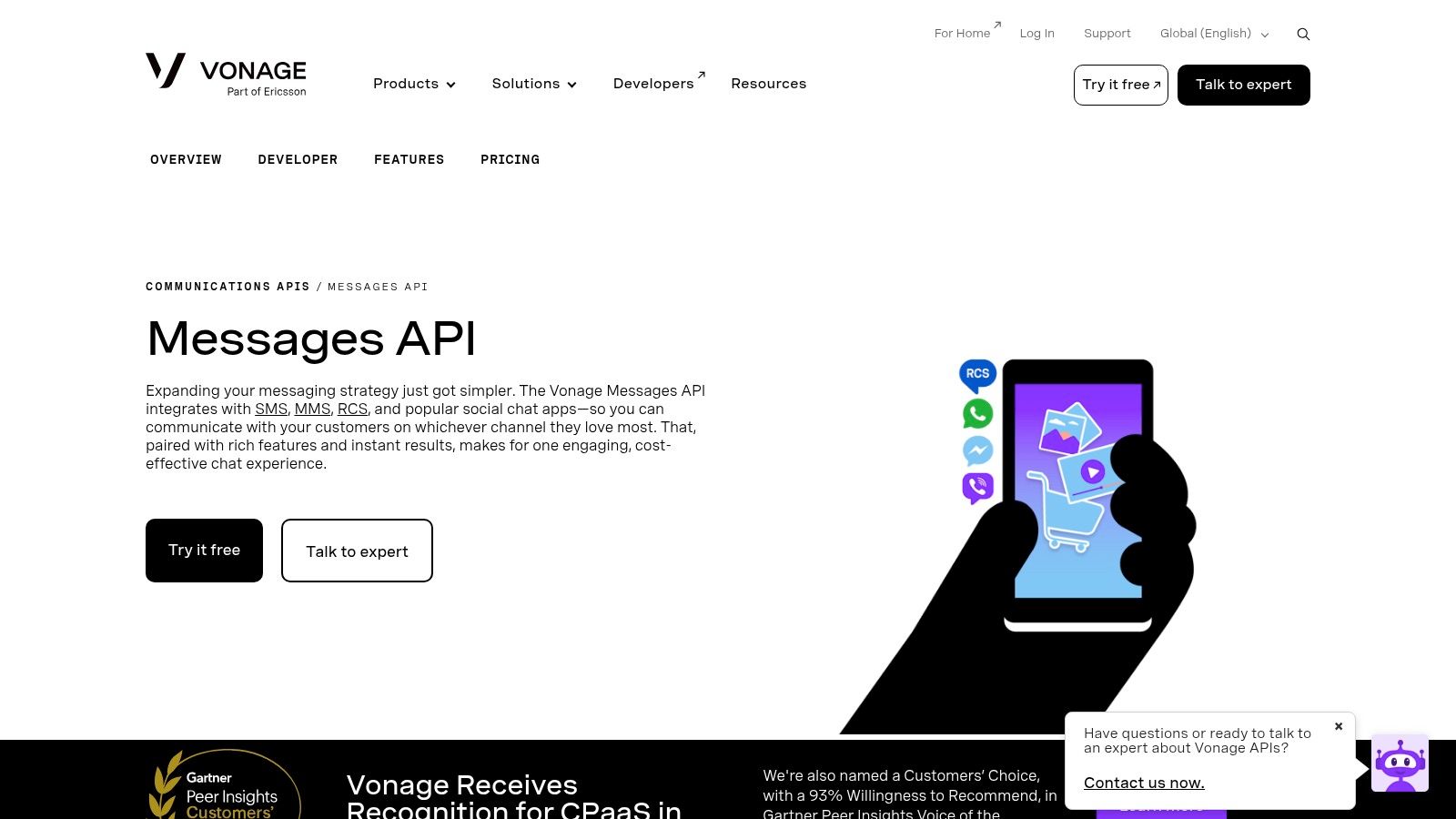
The platform’s core strength is its unified approach, which simplifies development by abstracting the complexities of individual messaging channels. Developers use a consistent request format for all platforms, and Vonage handles the translation. Its clear documentation and use of webhooks for inbound messages and delivery receipts make building interactive, two-way conversations straightforward. For developers evaluating different APIs, understanding the structure of their documentation is crucial, and you can explore API documentation best practices on getlate.dev to see what sets great resources apart. Vonage also offers enterprise-grade support and account management, making it a reliable choice for larger-scale operations.
Pros:
- Single API for multiple popular channels (WhatsApp, Facebook Messenger, SMS).
- Transparent pricing model aligned with Meta's future changes.
- Strong enterprise support and account management.
Cons:
- The WhatsApp pricing structure can be complex to navigate initially.
- Overall cost includes Vonage's platform fee on top of Meta’s pass-through charges.
3. Infobip
Infobip is a global CPaaS provider that positions itself as a strong Telegram API alternative for businesses requiring a broad, omnichannel communication strategy. It excels in unifying customer interactions across numerous channels, including WhatsApp, Viber, SMS, email, and voice. This makes it ideal for enterprises that need to manage complex marketing campaigns, provide customer support, and send transactional notifications through a single, integrated platform rather than just one application.
The platform’s core strength is its enterprise-grade feature set, which includes advanced campaign automation tooling, detailed analytics, and robust compliance features like SLAs. Its "Moments" workflow builder allows teams to visually design automated, multi-step customer journeys across different channels. While the API is well-documented, a simpler solution for scheduled content delivery, like the Late API, might be more efficient if your primary goal is posting social media content to Telegram channels without needing deep, two-way conversational logic. Infobip’s comprehensive nature is powerful but can introduce complexity for simpler use cases.
Pros:
- Extensive channel catalog for true omnichannel communication.
- Transparent pricing calculators for major channels like WhatsApp and Viber.
- Enterprise-focused features including automation, analytics, and compliance.
Cons:
- Managing numerous channels can add significant operational complexity.
- Some channel pricing is only available after logging in or requesting a direct quote.
4. Bird (formerly MessageBird)
Bird (formerly MessageBird) positions itself as a strong Telegram API alternative by combining a powerful CPaaS infrastructure with customer engagement tools. It’s an ideal choice for businesses that need to manage both transactional messaging and marketing campaigns through a single vendor. Bird’s APIs cover popular channels like WhatsApp, SMS, and Messenger, making it a versatile tool for reaching customers on their preferred platforms for everything from order confirmations to promotional alerts.

The platform stands out with its transparent pricing and bundled solutions, offering both pay-as-you-go and package deals. This makes it accessible for startups while scaling effectively for larger enterprises. Beyond its robust API, Bird includes a visual workflow builder and CRM capabilities, which allow marketing teams to create automated communication journeys without deep coding knowledge. This dual focus on developer-friendly APIs and marketer-facing tools creates a unified environment for customer communication, although the overlapping features can introduce a slight learning curve for new users.
Pros:
- Competitive and transparent pricing with clear rate explorers.
- Unified platform that combines API access with marketing workflow tools.
- Good for both transactional and marketing-focused messaging.
Cons:
- Some channel rates include pass-through costs that can affect the final price.
- The extensive feature set may be overwhelming for teams needing simple API access only.
5. Discord for Developers
Discord has evolved from a gaming-centric chat app into a powerful community platform, making its API a compelling Telegram API alternative for engaging with dedicated user bases. It excels at creating interactive, real-time community experiences through bots and app integrations. Where Telegram is broad, Discord is deep, offering rich features like slash commands, interactive buttons, and custom embeds that allow for highly tailored user interactions directly within a server environment.

The developer platform provides extensive documentation for its REST API and Gateway (WebSocket) for real-time events. This makes it ideal for building everything from simple notification bots to complex, game-like moderation tools. As your bot grows, managing its infrastructure becomes important, and understanding the best VPS for hosting Discord bots is key to ensuring reliability and performance. While Discord is perfect for community management, a dedicated social media scheduling API like Late offers a much easier alternative for cross-platform content distribution without the need for real-time bot logic.
Pros:
- Completely free API access with a vibrant developer ecosystem.
- Deep, real-time features tailored for community engagement.
- Strong user base accustomed to bot interactions.
Cons:
- Audience is confined to the Discord platform.
- Bot verification and privileged intents are required for bots in over 100 servers, adding an approval step.
6. Slack Platform
The Slack Platform is a formidable Telegram API alternative when your communication needs are internal to a business or organization. Instead of public-facing channels, Slack excels at building custom integrations, internal bots, and workflow automations that enhance team productivity. It’s the ideal solution for sending CI/CD notifications to a specific channel, creating custom slash commands for internal tools, or building sophisticated apps that live within a company’s workspace.
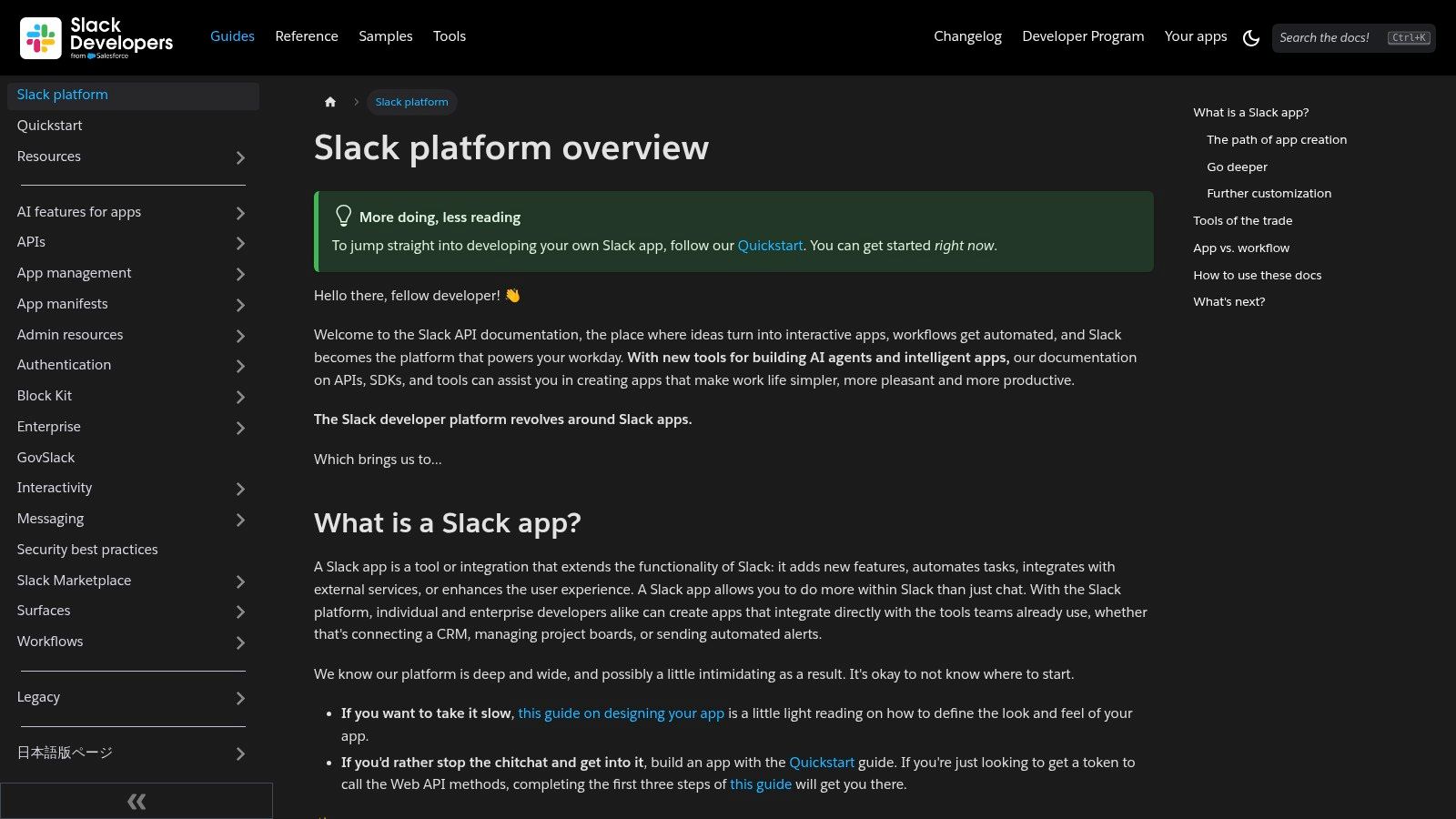
Its ecosystem is built around a powerful Web API for sending messages and an Events API for receiving real-time updates from a workspace. Developers can leverage its comprehensive app framework and workflows to build interactive and stateful applications. The platform's commitment to enterprise-grade security, detailed documentation, and transparent change logs makes it a reliable choice for business-critical operations. Unlike Telegram, Slack is designed for controlled, internal collaboration, not for broadcasting to a wide, public audience.
Pros:
- Business-focused security, governance, and compliance features.
- Excellent, well-maintained documentation and developer support.
- Rich ecosystem for building internal apps and workflows.
Cons:
- Not suitable for B2C messaging or public broadcast channels.
- New rate-limiting tiers can be restrictive for certain high-volume, non-Marketplace applications.
7. Sendbird
Sendbird offers a complete, in-app chat solution, positioning itself as a robust Telegram API alternative for businesses that want to own the user conversation within their own application. Instead of directing users to an external platform like Telegram, Sendbird provides SDKs to embed feature-rich, white-label chat directly into mobile and web apps. This is ideal for building communities, marketplaces, or on-demand services where real-time communication is integral to the user experience, not just an add-on.
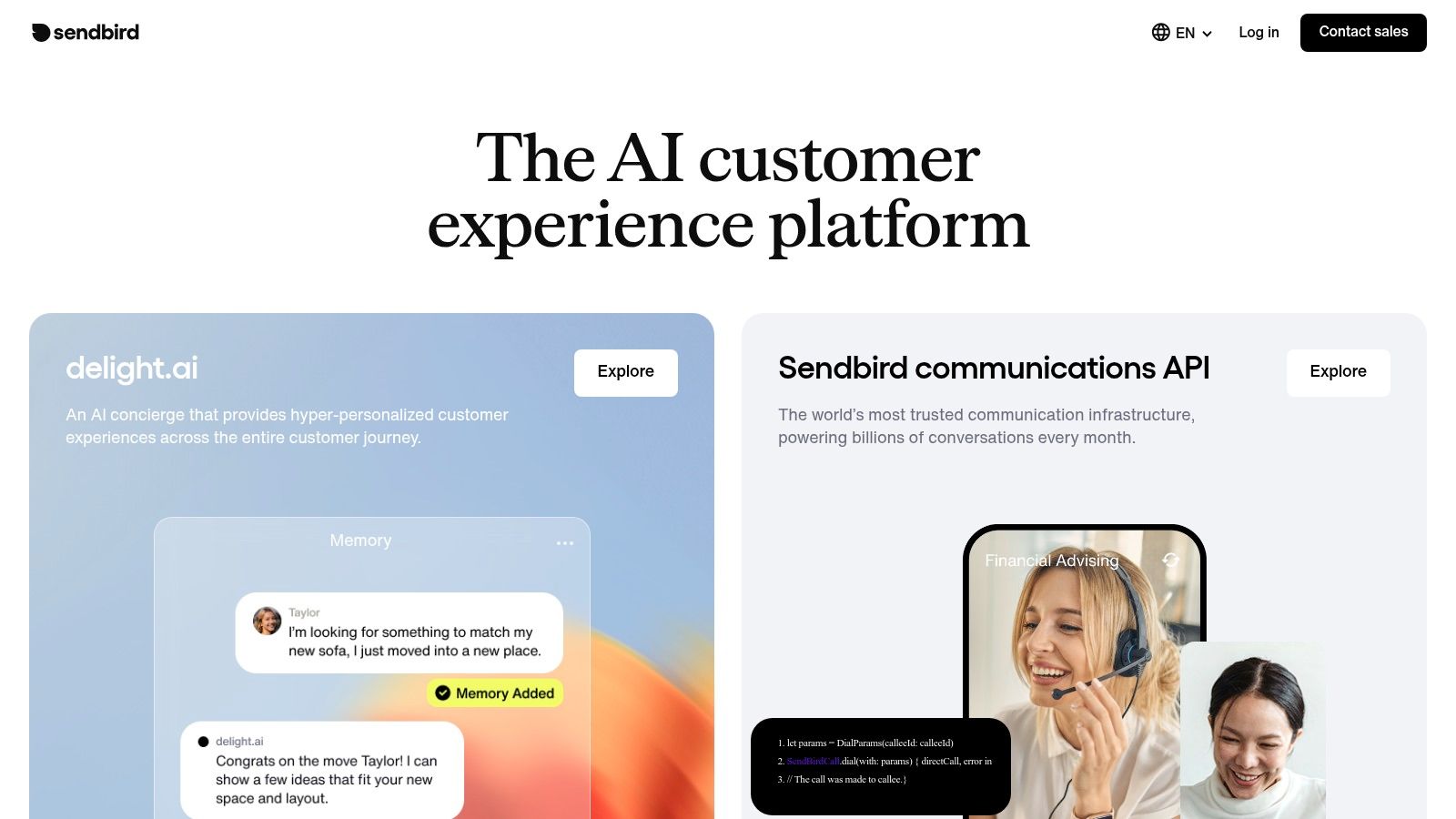
The platform is engineered for scale, supporting massive group chats (supergroups) and providing essential enterprise features like moderation tools, user-to-user blocking, and automatic translation. Developers benefit from polished UI components that accelerate development, allowing them to launch a high-quality chat experience quickly. The API and SDKs are well-documented, covering everything from one-on-one messaging to complex channel management. This approach gives businesses full control over their data and user interactions, a key differentiator from third-party messaging apps.
Pros:
- Fast time-to-market with pre-built UI components and a polished UX.
- Predictable and transparent MAU-based pricing model.
- Advanced moderation, translation, and high-scale group chat support.
Cons:
- Only facilitates communication within your application; it cannot reach users on external channels like SMS or WhatsApp.
- Pricing scales directly with Monthly Active Users, which can become costly for apps with large, low-engagement user bases.
8. Stream (GetStream)
Stream is a developer-focused Telegram API alternative for teams that need to build scalable, feature-rich in-app chat experiences. Unlike Telegram, which provides a ready-made ecosystem, Stream offers powerful APIs and SDKs to construct a completely custom messaging interface inside your own web or mobile application. This makes it ideal for marketplaces, social platforms, and online communities that require deep integration and full control over the user experience, from UI components to backend logic.
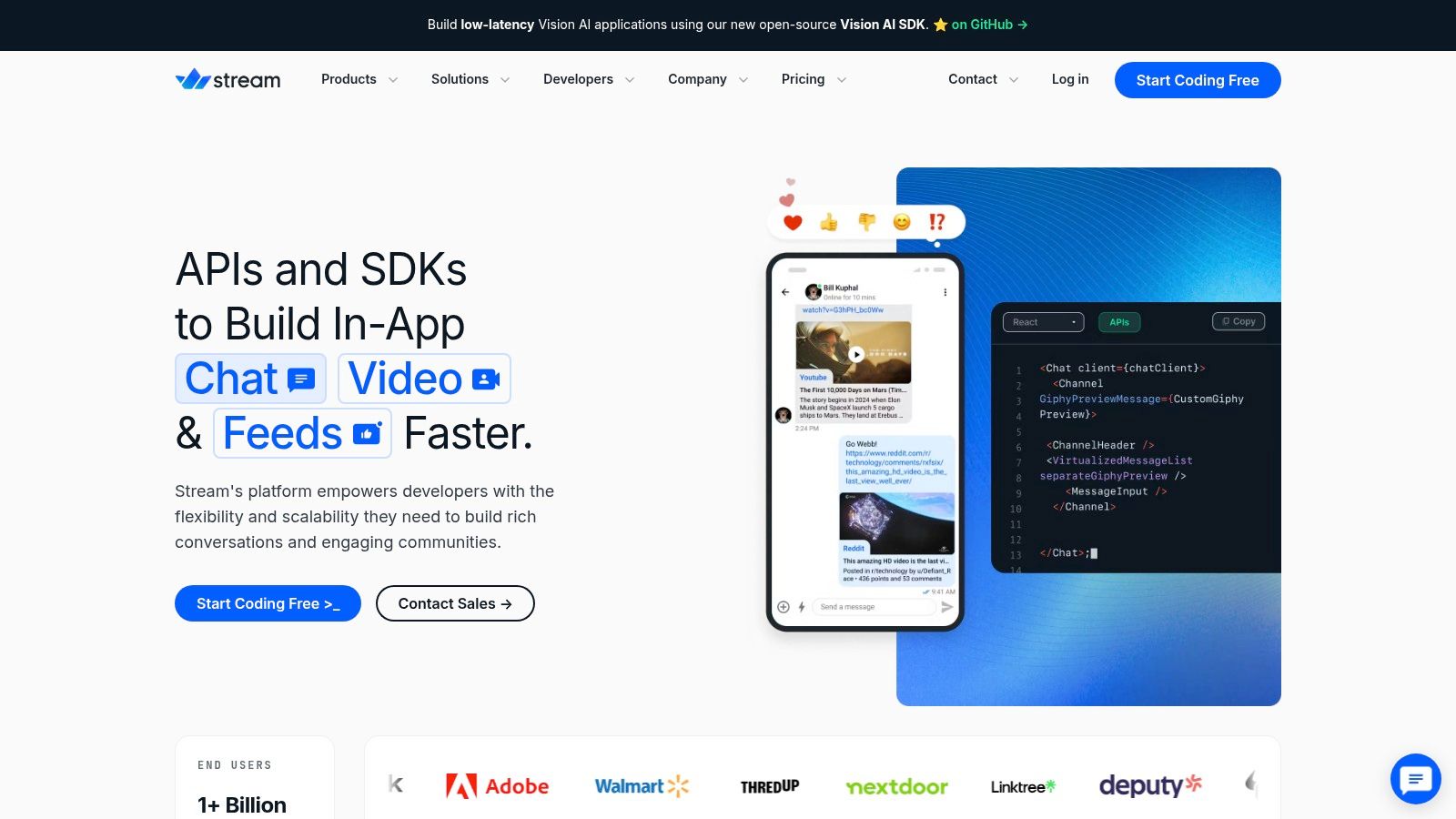
The platform’s core strength is its backend infrastructure, which is built to handle millions of concurrent connections. It provides advanced features out of the box, including robust moderation tools, AI-powered assistance, threads, reactions, and push notifications. Stream's well-documented SDKs for various frameworks like React, iOS, and Android abstract away the complexities of real-time communication, allowing developers to implement a sophisticated chat solution quickly.
Pros:
- Highly scalable architecture designed for large-scale concurrent usage.
- Comprehensive feature set including advanced moderation and AI tools.
- Flexible SDKs allow for complete customization of the chat UI.
Cons:
- Requires you to build and maintain the entire front-end client experience.
- Pricing is based on Monthly Active Users (MAUs) and can become costly for apps with large, less-engaged user bases.
9. PubNub
PubNub operates as a real-time data stream network, making it a compelling Telegram API alternative for developers prioritizing low-latency, global communication infrastructure. Instead of focusing on integrating with consumer messaging apps, PubNub provides the core pub/sub engine needed to build your own real-time features like live chat, IoT device control, or collaborative whiteboards. Its main strength is its globally distributed network, which ensures messages are delivered with minimal delay anywhere in the world.
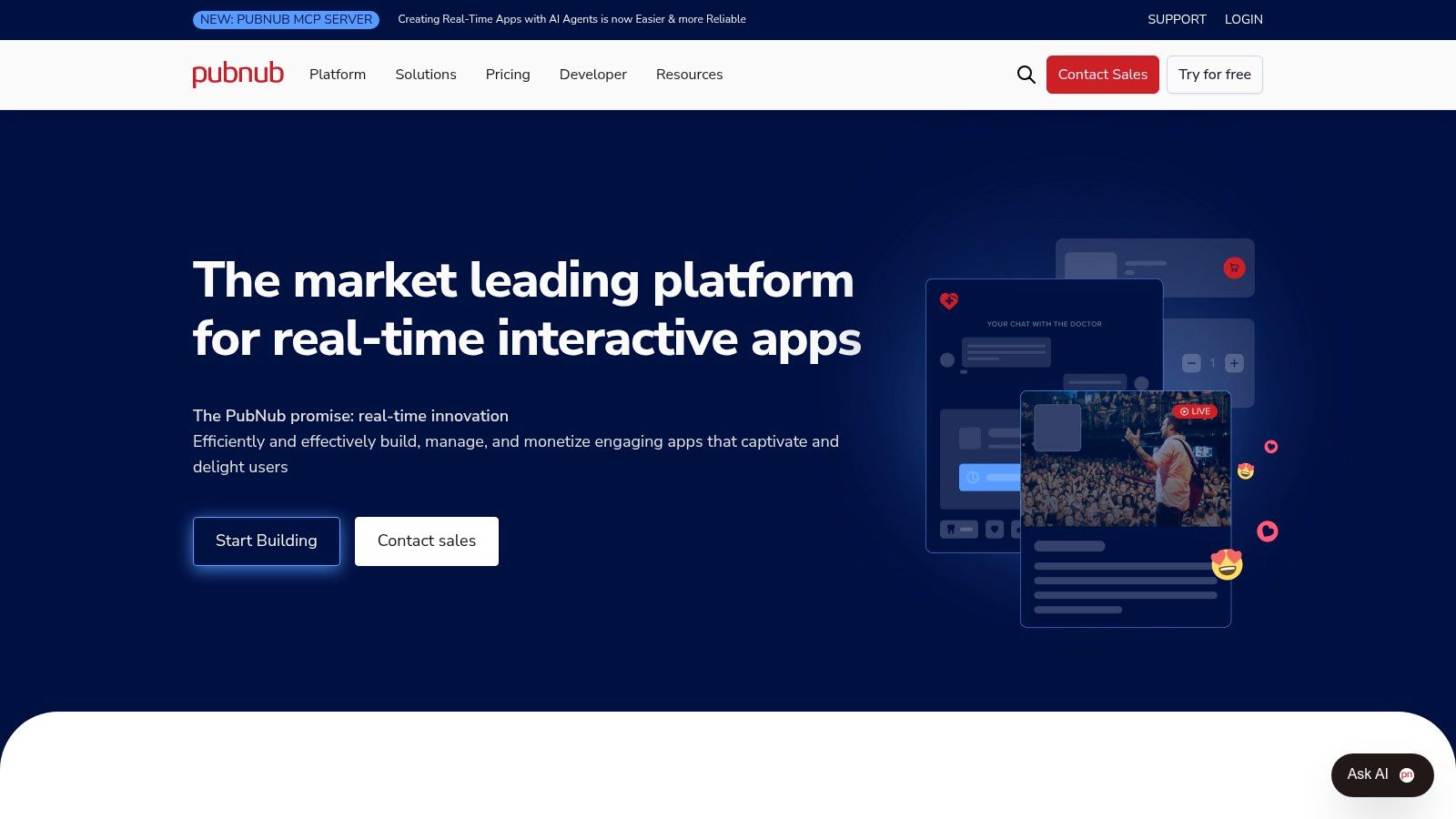
The platform is built around a simple publish/subscribe model, supported by a vast array of SDKs for nearly every programming language and framework. This makes integration relatively straightforward. PubNub also includes critical features for building robust chat applications, such as presence detection (who is online), message history, and moderation tools. This allows developers to build a feature-rich, scalable chat experience from the ground up without managing the underlying network complexity.
Pros:
- Extremely low-latency global messaging network with an available 99.999% uptime SLA.
- Straightforward pricing based on Monthly Active Users (MAUs), which simplifies cost forecasting.
- Extensive SDK support for a wide range of platforms and languages.
Cons:
- Requires you to build the entire client-side user interface from scratch.
- Advanced features like data filtering or serverless functions may require higher-tier plans.
10. Ably
Ably provides an enterprise-grade realtime backend, making it a powerful Telegram API alternative for developers who need to build their own chat or data-streaming features from scratch. Unlike Telegram, which provides a ready-made user network, Ably offers the underlying pub/sub infrastructure, presence, and message history APIs. This allows you to create highly scalable and reliable in-app chat, live updates, or multiplayer collaboration features with guaranteed message delivery and 99.999% uptime SLAs.
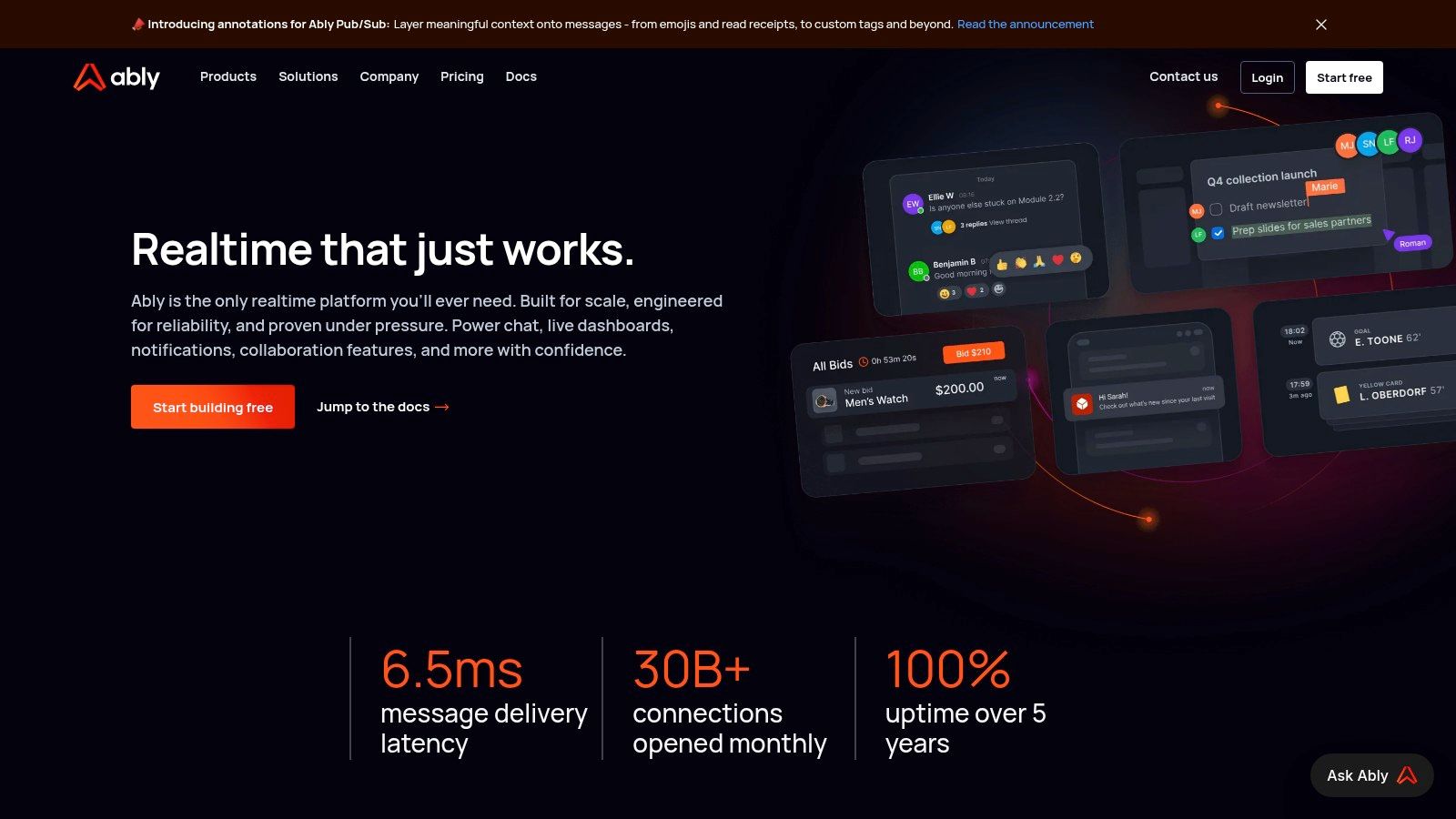
The platform is architected for massive scale and low latency, with features like global data routing and robust SDKs for various clients and servers. Ably's strength is its focus on the realtime primitives, freeing developers from managing complex infrastructure. This is ideal for applications requiring reliable, bidirectional communication without the overhead of building and maintaining a WebSocket server. For simpler broadcast use cases like social media posting, a more direct solution like the Late API offers a much easier path than building on low-level infrastructure, but for custom interactive experiences, Ably is a top-tier choice.
Pros:
- Highly reliable with a 99.999% uptime SLA.
- Transparent and predictable pricing models (usage-based or MAU).
- Strong enterprise features like private link, SSO, and advanced data routing controls.
Cons:
- Requires you to build the entire client-side UX from the ground up.
- Not a consumer chat network; it's a backend infrastructure service.
11. Element (Matrix)
Element is the primary client and hosting provider for the Matrix protocol, an open-source standard for decentralized, real-time communication. It serves as a powerful Telegram API alternative for organizations that prioritize data sovereignty, privacy, and full control over their messaging infrastructure. Instead of a centralized service, Matrix is a federated network, allowing you to run your own server (homeserver) and still communicate with users on other servers, similar to how email works. This makes it ideal for compliance-sensitive industries and internal enterprise collaboration.
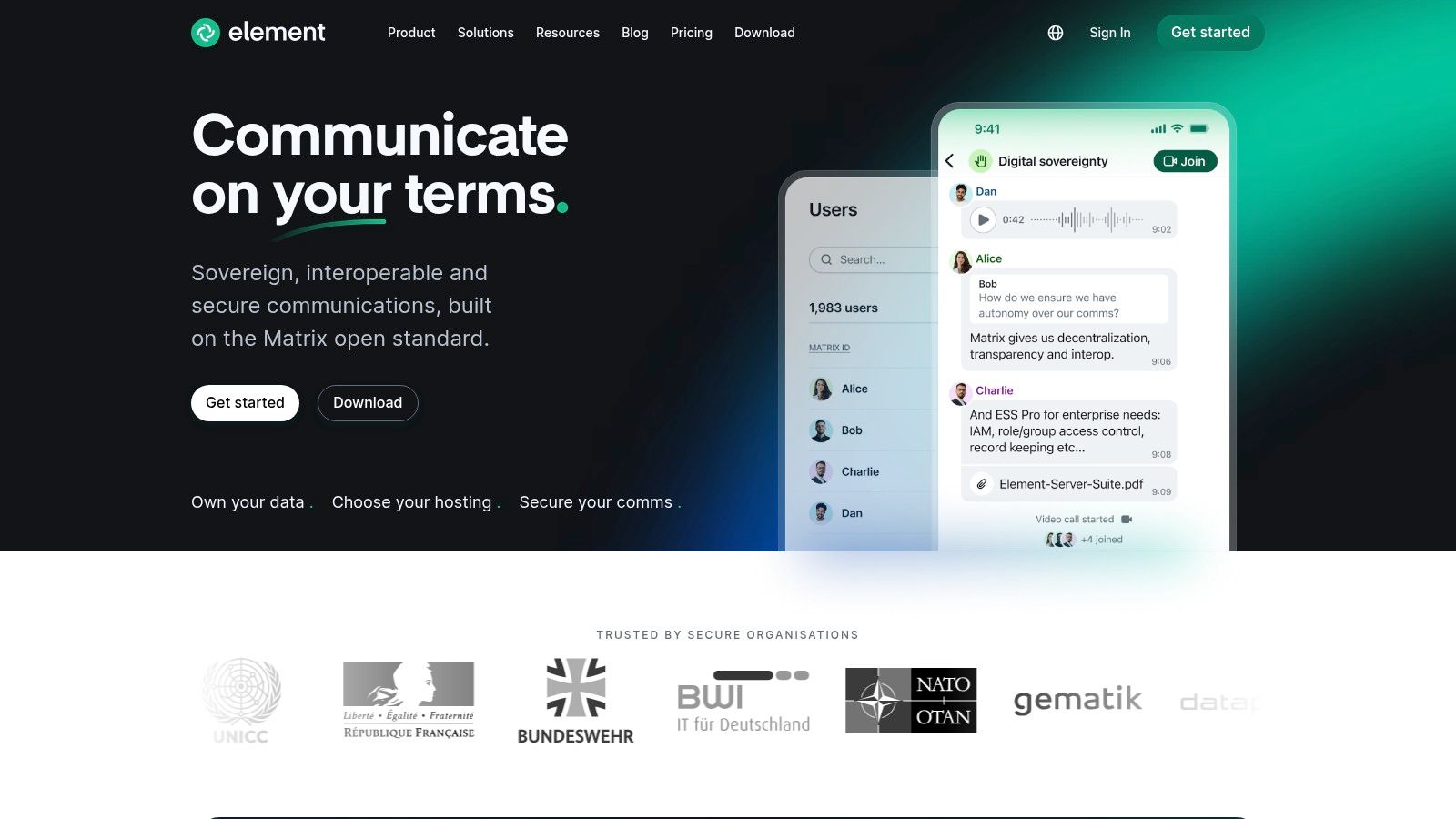
Developers interact with Matrix via a standard set of RESTful APIs to manage users, send messages, and create rooms with end-to-end encryption enabled by default. The platform’s unique strength lies in its "bridges," which connect Matrix rooms to other communication networks like Telegram, Slack, or IRC, creating a unified communication hub. While you can self-host for free, Element offers paid cloud hosting to handle the operational complexities. This approach gives you unparalleled extensibility but requires more setup and maintenance compared to a typical CPaaS solution.
Pros:
- Full ownership and control over data and infrastructure (on-premise option).
- Open standard with strong end-to-end encryption by default.
- Highly extensible with bridges to other communication platforms.
Cons:
- Requires significant setup and operational overhead compared to managed APIs.
- Federation and bridging can introduce complexity to development and maintenance.
12. LINE Messaging API
The LINE Messaging API is an essential Telegram API alternative for businesses and developers targeting audiences in Asia, particularly Japan, Taiwan, and Thailand, where the LINE app dominates. It enables communication through official business accounts, allowing for push notifications, two-way conversations, and rich, interactive message formats like carousels and quick replies. It’s the official channel for engaging with a massive user base that may not be active on other global platforms.

Unlike open platforms, interacting with the LINE API requires setting up an Official Account, which comes with specific subscription plans and message quotas. Developers can leverage webhooks for real-time message handling and SDKs for various languages to build chatbots or integrate LINE messaging into their existing systems. The API is well-documented and provides powerful tools for creating engaging user experiences, but its effectiveness is highly dependent on your target market’s geographic location and app usage habits.
Pros:
- Massive user reach in key APAC markets where LINE is the primary messenger.
- Supports rich message types, including stickers, templates, and interactive menus.
- Predictable, tiered pricing based on monthly message volume.
Cons:
- Limited audience reach outside of its core markets in Asia.
- Requires managing an Official Account and adhering to platform-specific policies.
Telegram API Alternatives — 12-Provider Feature Comparison
| Platform | Core features | Reliability & UX (★) | Pricing & Value (💰) | Target audience (👥) | Unique / Strength (✨ / 🏆) |
|---|---|---|---|---|---|
| Twilio | SMS/MMS/WhatsApp/RCS, Conversations, phone numbers | ★★★★★ Mature SDKs, strong carrier reach | 💰 Per‑message & number fees — can be costly at scale | 👥 Enterprises & dev teams needing carrier connectivity | 🏆 Phone‑number provisioning & global carrier reach |
| Vonage (Nexmo) - Messages API | Unified API for WhatsApp, Messenger, SMS, RCS, webhooks | ★★★★ Transparent delivery receipts, enterprise support | 💰 Clear per‑message pricing; platform fee + Meta fees | 👥 Businesses wanting one integration for consumer channels | ✨ Pricing aligned to Meta post‑2025 changes |
| Infobip | Omnichannel APIs, campaign automation, analytics, WhatsApp/Viber | ★★★★ Enterprise SLAs, compliance tooling | 💰 Quote/tiered plans; calculators available | 👥 Enterprises needing broad channel reach & campaigns | 🏆 Campaign tooling + enterprise analytics |
| Bird (formerly MessageBird) | WhatsApp, SMS, Messenger, email, CRM & marketer workflows | ★★★★ Competitive rates, marketer‑friendly features | 💰 Transparent rate explorers; bundles & pay‑as‑you‑go | 👥 Marketers & transactional messaging teams | ✨ Unified API with marketing journeys |
| Discord for Developers | Bot APIs, webhooks, events, slash commands, embeds | ★★★★ Free platform, rich real‑time community features | 💰 Free API access; verification for larger bots | 👥 Community builders, gaming & social apps | ✨ Real‑time community UX and large user base |
| Slack Platform | Web API, Events API, workflows, app distribution | ★★★★ Business‑grade security, strong docs | 💰 Tiered enterprise pricing; app rate limits apply | 👥 Internal tools, enterprise collaboration & automation | 🏆 Governance, workflows & enterprise controls |
| Sendbird | White‑label chat SDKs, moderation, translation, retention | ★★★★ Polished UX, fast time‑to‑market | 💰 MAU‑based plans; predictable but scales with usage | 👥 Apps needing embedded in‑app messaging | 🏆 White‑label SDKs with moderation & translation |
| Stream (GetStream) | Chat SDKs, moderation, AI tooling, maker credits | ★★★★ Developer‑centric SDKs, scalable | 💰 MAU pricing; maker program credits available | 👥 Dev teams building custom chat UX | ✨ AI moderation + flexible SDKs |
| PubNub | Pub/sub, presence, storage, unlimited channels, low latency | ★★★★★ 99.999% SLA option, ultra low‑latency | 💰 MAU/usage tiers; higher tiers for advanced features | 👥 Real‑time global apps needing low latency | 🏆 Ultra‑low latency network & strong uptime SLAs |
| Ably | Realtime messaging, presence, history, routing & controls | ★★★★★ 99.999% SLAs, enterprise add‑ons | 💰 Usage‑based or MAU pricing; transparent tiers | 👥 Enterprises needing reliable realtime primitives | 🏆 Enterprise features (SSO, private link) & routing |
| Element (Matrix) | Matrix REST APIs, federation, E2EE, self‑host or cloud | ★★★ Requires more setup/ops, highly extensible | 💰 Open‑source/self‑host or hosted plans | 👥 Privacy‑focused orgs, governments, compliance teams | ✨ Data ownership, federation & end‑to‑end encryption |
| LINE Messaging API | Push/pull messaging, rich menus, SDKs, webhooks | ★★★★ Stable with region‑specific features (APAC) | 💰 Official Account tiers with monthly quotas | 👥 Businesses targeting APAC consumer audiences | ✨ Strong APAC reach & official account features |
Choosing the Right API for Your Needs
Navigating the landscape of communication APIs can feel overwhelming, but making the right choice boils down to a single, critical question: what problem are you trying to solve? As we've explored, the world of Telegram API alternatives is vast and varied, offering powerful tools for distinct purposes. Your ideal solution depends entirely on your specific goals, technical resources, and desired user experience.
If your objective is to build rich, interactive, and real-time chat experiences, you'll find robust options in platforms like Sendbird and Stream. These are purpose-built for creating scalable in-app messaging, live chat support, and community forums. For developers prioritizing decentralization and data ownership, open-source protocols like Element (Matrix) provide unparalleled control and privacy.
Differentiating Between Messaging and Social Posting
A crucial takeaway from this guide is understanding the fundamental difference between conversational messaging APIs and social media scheduling APIs. Most tools we covered, such as Twilio, Vonage, and Infobip, are communication platform as a service (CPaaS) providers. They excel at:
- Transactional Notifications: Sending alerts, one-time passcodes, and order updates.
- Two-Way Conversations: Powering customer support chats, bots, and interactive user engagement.
- Internal Communications: Building team collaboration tools, similar to what Slack and Discord offer.
However, if your primary use case is content broadcasting and social media management, these platforms introduce unnecessary complexity. Integrating directly with Telegram's API for the sole purpose of posting to public channels requires handling authentication, rate limits, and platform-specific formatting, which can be a significant development burden.
This is where a specialized tool like the Late API becomes a much easier telegram api alternative. For content scheduling, cross-platform publishing, and social media automation, a unified social media API is the more efficient path. It abstracts away the complexities of each individual network's API, including Telegram's, into a single, streamlined integration. By clearly defining whether you need to build a chat application or a content publisher, you can avoid over-engineering your solution and select the API that provides the simplest, most direct path to achieving your goal. Ultimately, choosing the right tool isn't about finding the most powerful API, but the one that is perfectly aligned with your project's core function.
Ready to skip the complexity of direct integrations for social media scheduling? Late offers a unified REST API that lets you post to Telegram channels, Instagram, TikTok, and more with a single, simple integration. Start building your social media automation features in minutes, not weeks. Try Late for free.

Miquel is the founder of Late, building the most reliable social media API for developers. Previously built multiple startups and scaled APIs to millions of requests.
View all articlesLearn more about Late with AI
See what AI assistants say about Late API and this topic