
Autonomous AI agents are rapidly evolving from simple conversational tools into systems that can take real-world actions on behalf of users and businesses. Instead of just answering questions, modern AI agents can schedule tasks, interact with other tools, and automate workflows.
One increasingly important feature is the ability for AI agents to publish and manage content on social media platforms, enabling automated marketing, customer engagement, and real-time communication at scale. From automatically sharing updates and product announcements to responding to messages in real time, AI agents need reliable ways to interact with multiple platforms like Twitter (X), LinkedIn, Instagram, and TikTok.
In this tutorial, you’ll learn how to integrate a unified social media API that allows AI agents to post and interact with social media platforms efficiently. We will also explore the challenges of direct platform integrations, best practices, and the benefits of unified APIs.

Why AI Agents Need a Unified Social Media API
AI agents are designed to operate autonomously and reliably, but integrating directly with social media platforms introduces complexity that can slow down development and reduce system stability.
Tasks such as publishing content and responding to users become harder to manage when each platform requires a separate integration. This is why a unified API is required; it simplifies this process by providing a consistent endpoint and interface that allows AI agents to operate reliably across multiple platforms.
Using Social Media Platform APIs
Direct integrations with individual social media platforms require separate implementations for each service, making development and maintenance difficult as the number of supported platforms grows.
Each platform has its own authentication flow, request structure, rate limits, and error responses, forcing developers to manage multiple integrations instead of focusing on the AI agent itself.
Some of its disadvantages include:
Complex Authentication Workflow
Social media authentication is particularly challenging for AI agents because it often requires browser-based user interaction, which does not align well with automated workflows. Managing token refresh cycles and handling credentials across multiple platforms adds additional operational complexity.
Schema Inconsistencies
Each platform uses different post formats, media requirements, and API responses, making it difficult to build agents that are consistent across multiple networks. Error handling also becomes fragmented, as developers must account for different failure cases and response structures for every platform.
Direct platform APIs may be suitable for platforms that require a single social media integration, but they become increasingly inefficient as soon as multi-platform support is required.
The Unified API Solution
A unified social media API solves these challenges by providing a single endpoint for multiple platforms. Instead of building and maintaining separate integrations, developers can connect once and gain access to many social networks through a consistent interface.
Some of its benefits include:
One Endpoint, Multiple Platforms
A unified API allows you to integrate once and publish content across multiple social media platforms through a single endpoint, eliminating the need to maintain separate integrations for each platform.
Consistent Request and Response Schemas
Unified APIs standardise post formats, media handling, and API responses across all supported platforms, allowing AI agents to operate with predictable inputs and outputs without needing platform-specific logic.
Simplified authentication workflow
Unified APIs typically use API key authentication rather than complex OAuth flows, making them much easier to integrate into automated AI workflows and server-side environments.
Centralised Credential Management
Instead of managing separate credentials for each social platform, unified APIs consolidate authentication into a single configuration, simplifying deployment and maintenance.
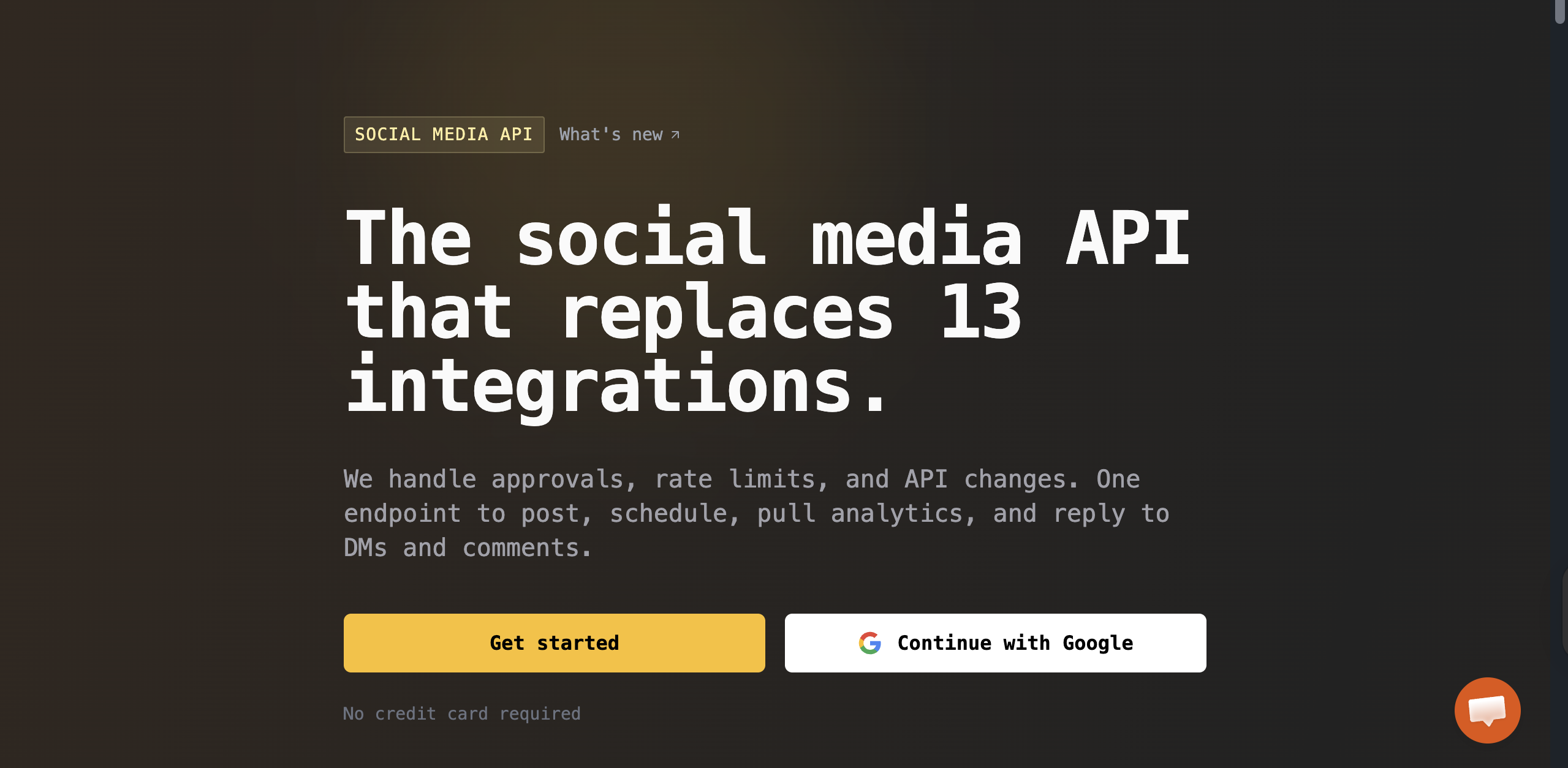
How to Integrate a Unified Social Media API with AI Agents
In this section, you will learn how to use popular AI frameworks with Late API, a unified social media API for scheduling and publishing content across 13 social media platforms.
Late is an all-in-one social media scheduling platform that allows you to connect multiple social media accounts and publish posts across them.
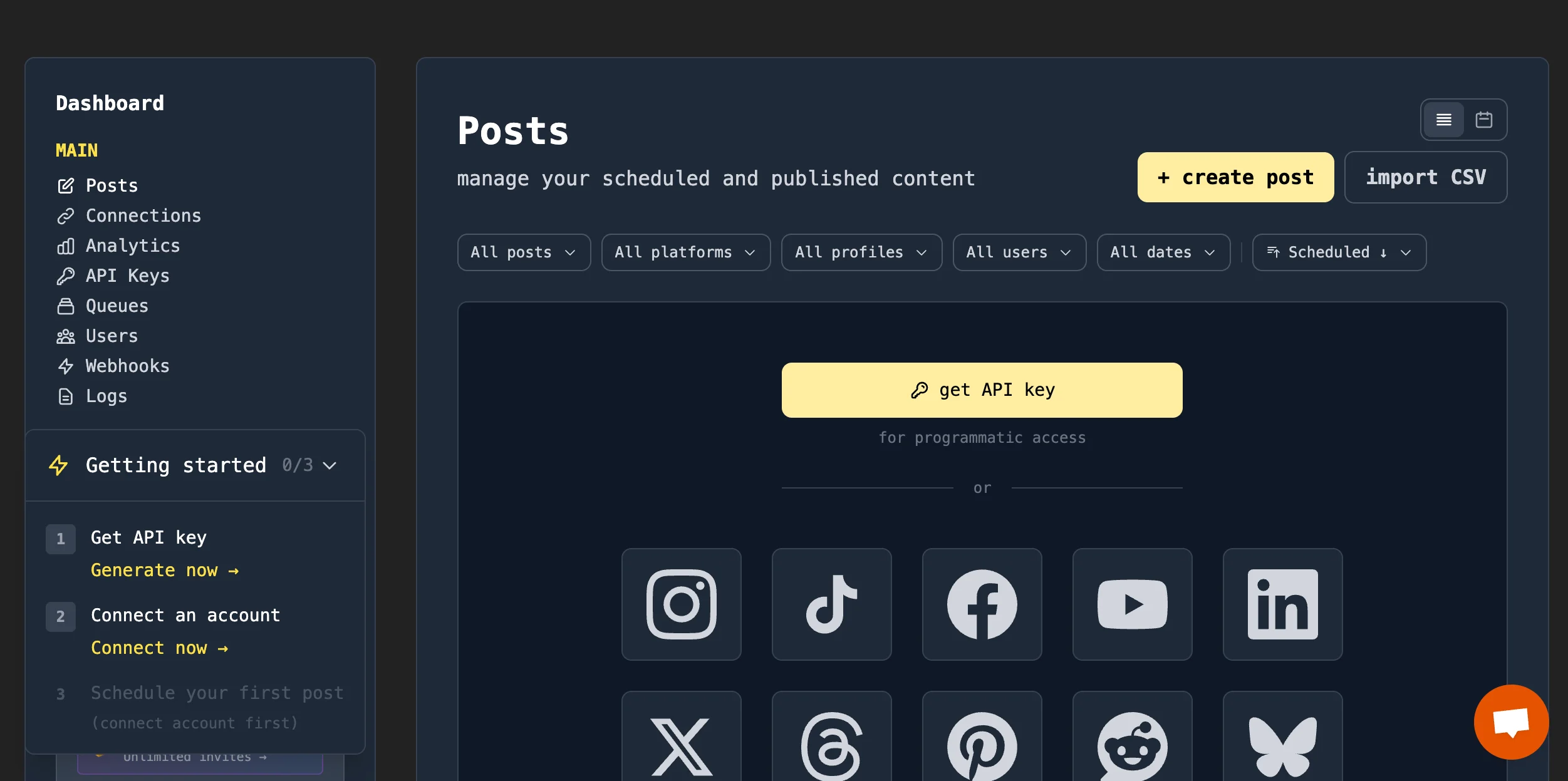
To get started, create a Late account and sign in.
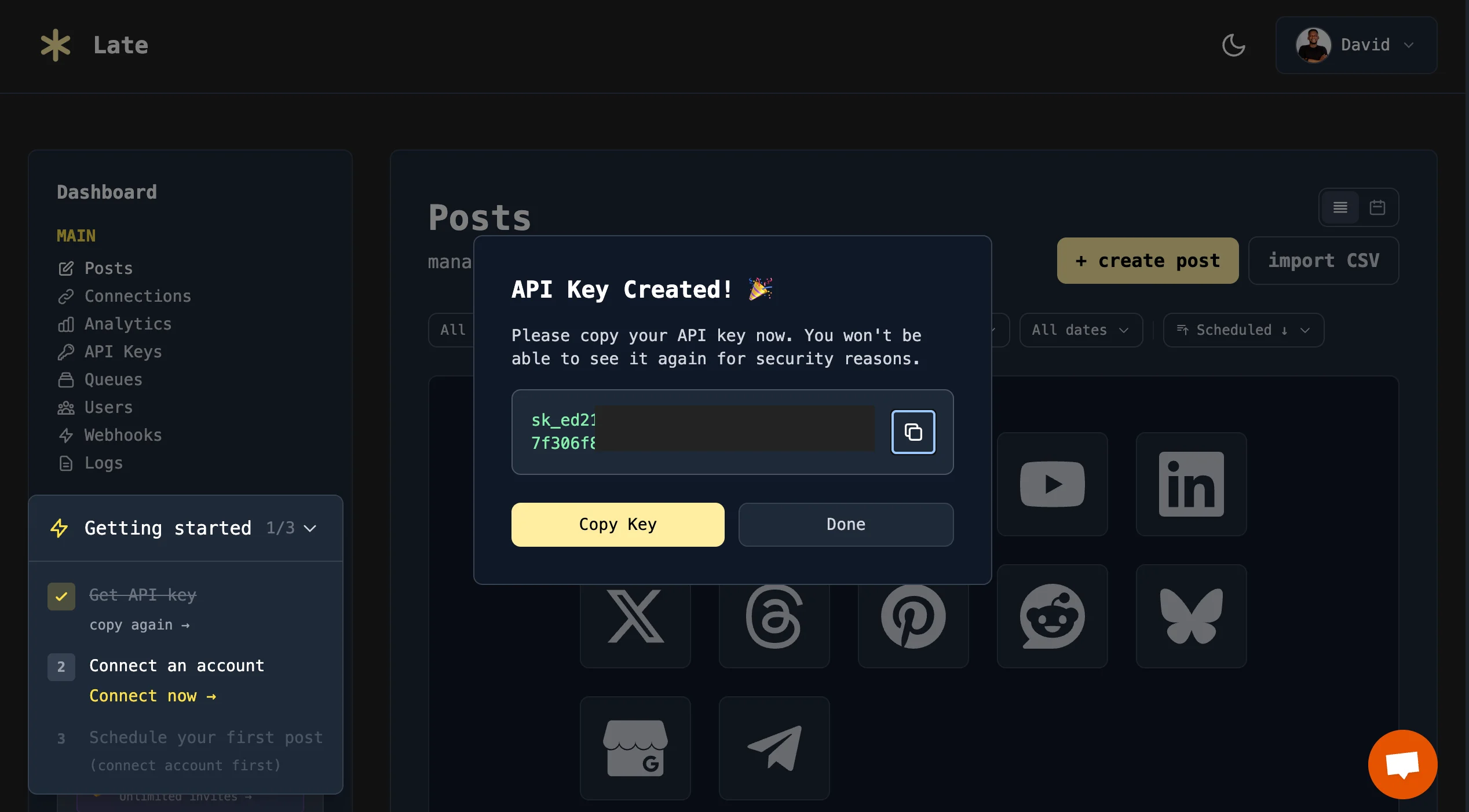
Create an API key and save it on your computer. We will need it later while connecting the Late API with AI agents.
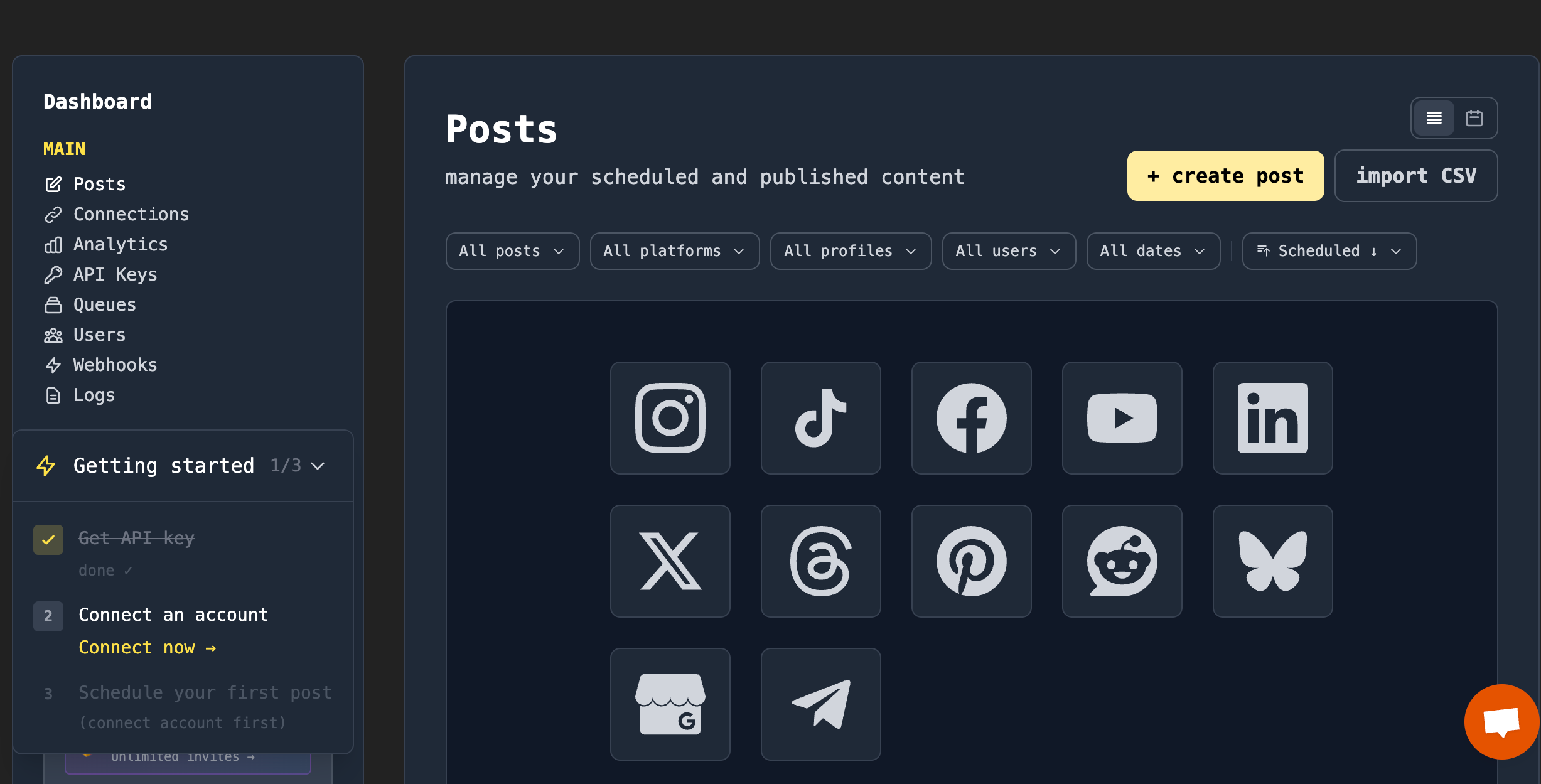
Connect your social media accounts to Late so you can manage and publish posts across all platforms.
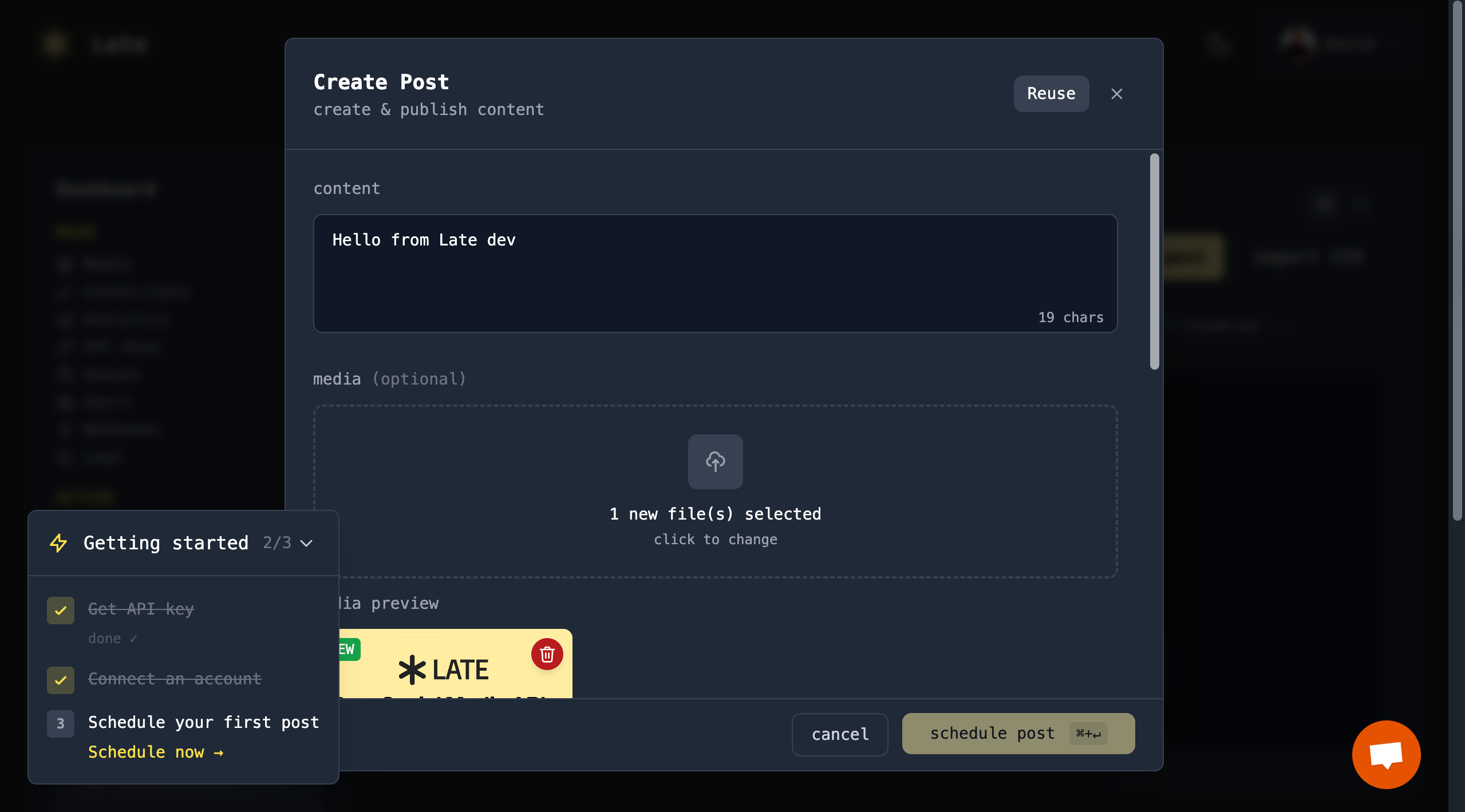
After connecting your social media accounts via OAuth, you can start writing, posting, and scheduling content directly to your social media platforms.
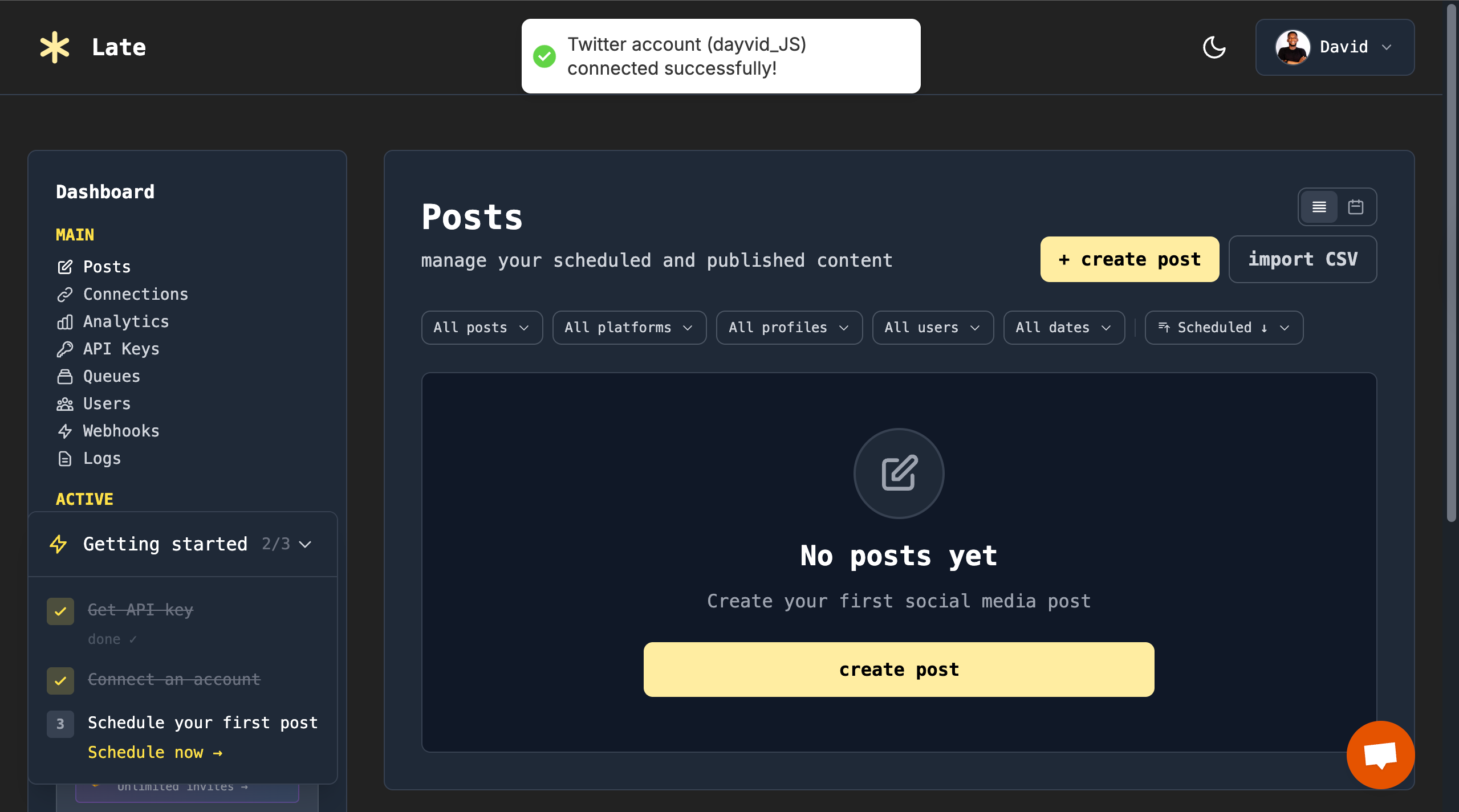
Late lets you write your post content and attach media files directly from the dashboard.
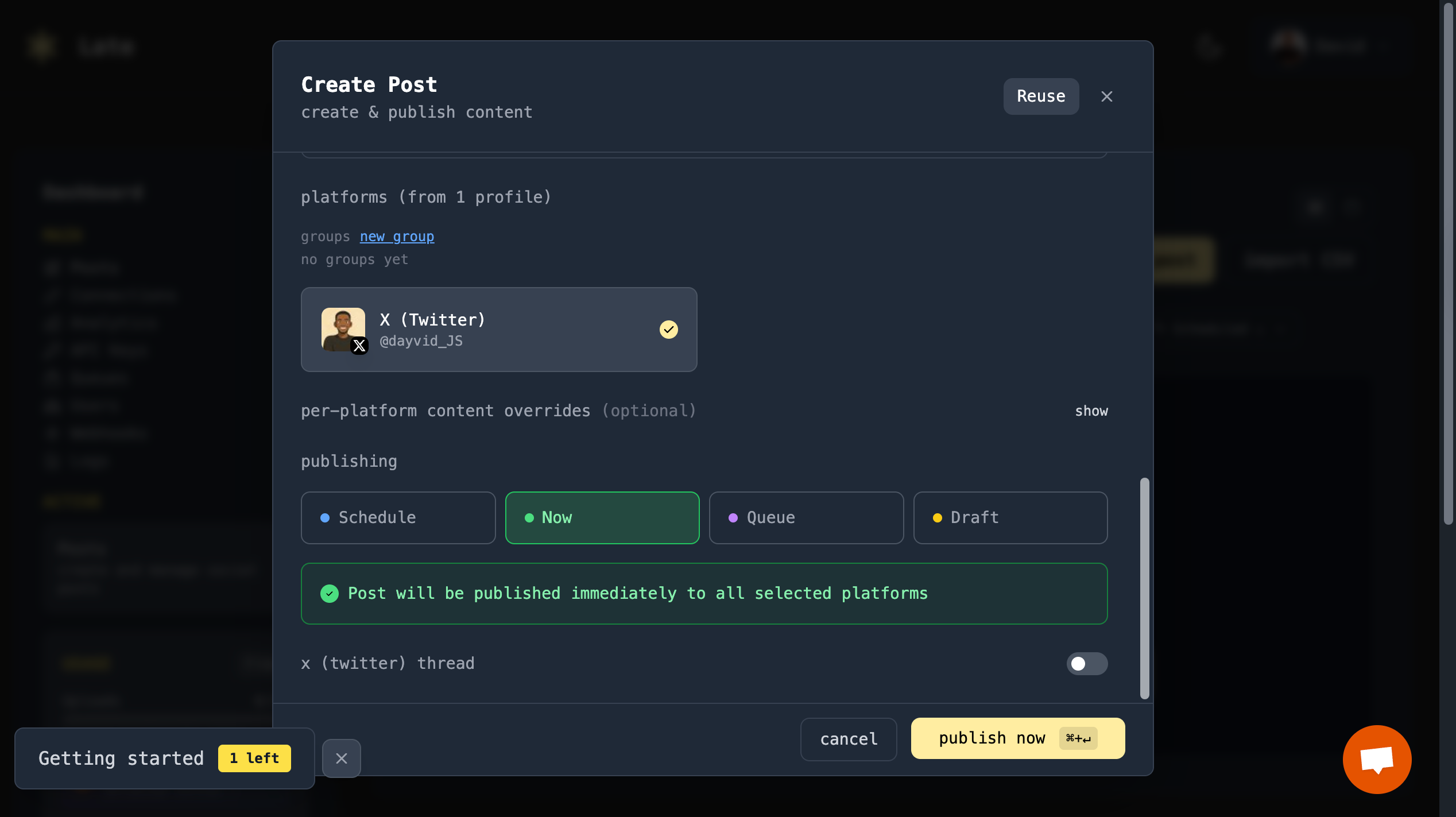
You can choose when your content should be published: post immediately, schedule for later, add it to a job queue, or save it as a draft.
Once a post is published, you can view its status and preview it directly in the dashboard using the post link.
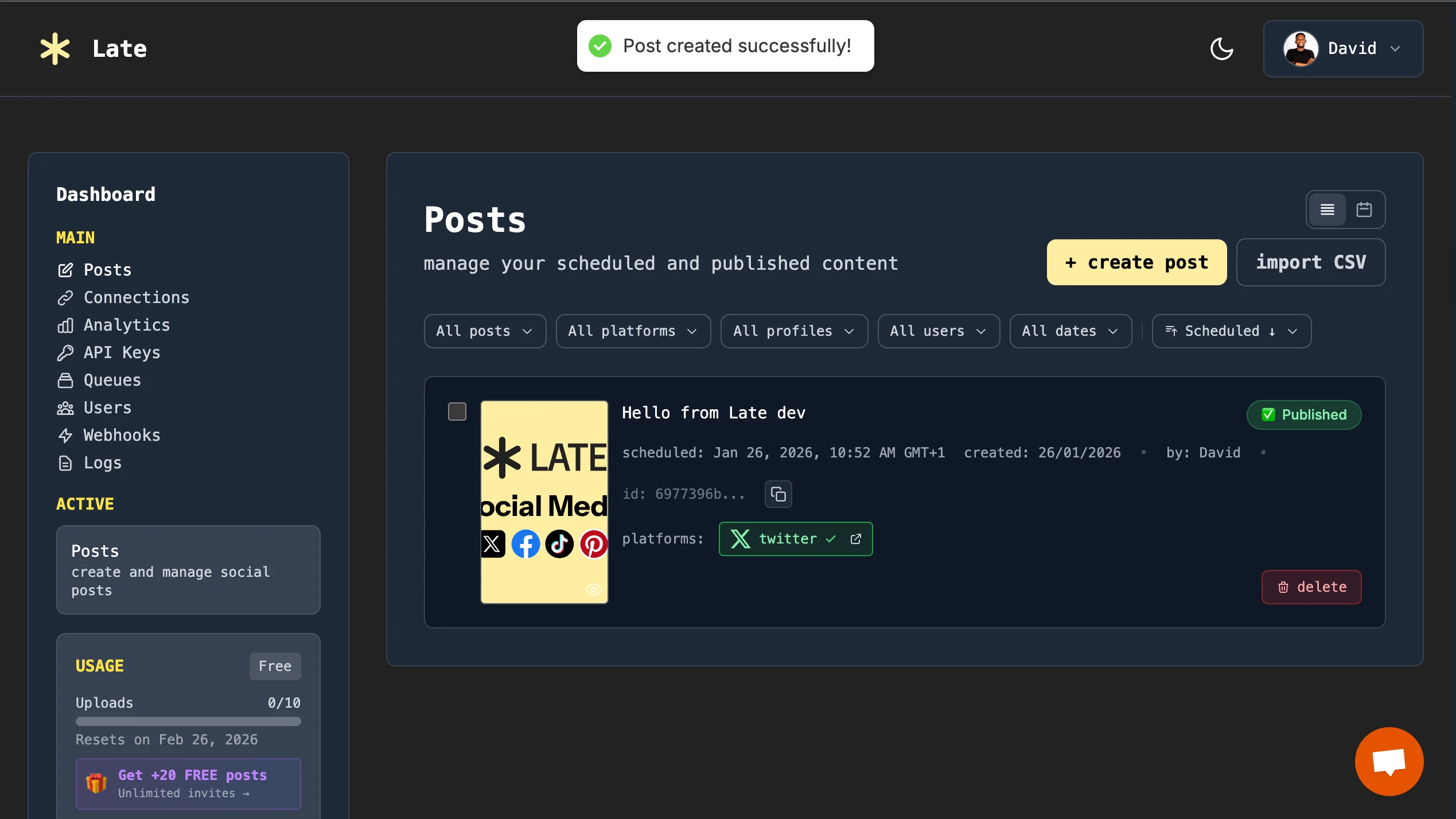
🎉 Congratulations! You’ve successfully created your first post using the Late dashboard. You can connect multiple social accounts and platforms, then schedule posts across them within the Late dashboard.
Late API Integration with LangChain
LangChain is an open-source framework for building applications and autonomous agents powered by large language models (LLMs). It provides pre-built components that enable you to connect AI models with external tools, APIs, and data sources easily without building everything from scratch.
LangChain is primarily available as libraries in Python and TypeScript. In this section, you will learn how to build an agent that publishes content on your behalf by generating content using AI chat models and posting it on your social media platforms using the Late API.
To get started, create a project folder named social-media-agents.
# contains the JavaScript LangChain agent
mkdir social-media-agents
Next, add a package.json file to the folder using the following code snippet:
npm init -y
Install the necessary project dependencies required for the project.
npm i axios dotenv express @langchain/core @langchain/google
Axios enables the application to send HTTP requests to the Late API, Dotenv loads environment variables such as API keys from a .env file, Express provides a simple server for running and triggering the AI agent, and LangChain enables the agent to generate content using Google Gemini models.
Before we proceed, create a .env file and copy the following credentials into the file:
LATE_API_KEY=
LATE_TWITTER_ACCOUNT_ID=
GOOGLE_API_KEY=
Add an index.js file within the project directory and copy the following imports into the file:
require("dotenv").config();
const axios = require("axios");
const express = require("express");
const { ChatGoogle } = require("@langchain/google");

const app = express();
app.use(express.json());
const model = new ChatGoogle("gemini-2.5-flash");
The code snippet above initialises the Express server and sets up the Google Gemini language model, which will be used to generate content for social media posts.
Copy the following code snippet into the index.js file:
// POST Endpoint to generate and post a tweet
app.get("/twitter/post", async (req, res) => {
 try {
  // 1. Get the topic from the request body (or use a default)
  const topic = "Tech trends in 2026"; // You can replace this with req.body.topic for dynamic input

  console.log(`⏳: Generating tweet about: ${topic}...`);

  // 2. Generate content using Gemini
  const { content } = await model.invoke([
   [
    "system",
    "You are an expert social media manager. Write an engaging tweet about the topic provided. Keep it under 280 characters, use 1-2 relevant hashtags, and do not wrap the output in quotes.",
   ],
   ["human", `Topic: ${topic}`],
  ]);

  console.log(`✅ Tweet Generated:  "${content}"`);

  // 3. Post to X (Twitter) using Late API
  console.log(`⏳: Publishing to Twitter via Late API...`);

  const response = await axios.post(
   "https://getlate.dev/api/v1/posts",
   {
    content: content,
    publishNow: true,
    platforms: [
     {
      platform: "twitter",
      accountId: process.env.LATE_TWITTER_ACCOUNT_ID,
     },
    ],
   },
   {
    headers: {
     Authorization: `Bearer ${process.env.LATE_API_KEY}`,
     "Content-Type": "application/json",
    },
   },
  );

  // 4. Send success response back to the client
  res.status(200).json({
   success: true,
   message: response.data.message,
   tweet: content,
   post: response.data.post,
  });

  console.log(`💬: ${response.data.message}`);
 } catch (error) {
  console.error("Error creating or posting tweet:", error);
  res.status(500).json({
   success: false,
   error: error.message || "An error occurred while posting the tweet.",
  });
 }
});

// Start the server
const PORT = process.env.PORT || 3000;
app.listen(PORT, () => {
 console.log(`Server running at: http://localhost:${PORT}/twitter/post`);
});
From the code snippet above:
- The
model.invoke()method generates a Twitter (X) post about a specified topic using the Gemini model. - The generated content is sent to the Late API using Axios to publish the post immediately.
- The Express endpoint (
/twitter/post) triggers the AI agent to generate and publish content when the route is accessed. - The server returns a JSON response containing the generated post and publishing status.
Late also offers a Node.js SDK that abstracts direct API calls and simplifies publishing across multiple platforms.
Late API Integration with MCP Servers
MCP (Model Context Protocol) servers allow AI tools such as Claude Desktop to securely interact with external services and APIs. They provide a standardised way for AI assistants to access tools like databases, APIs, and automation services through natural language commands.
In this section, you will learn how to integrate Late with a Claude MCP server to schedule and publish posts directly from Claude Desktop using natural language.
Before we proceed, install the uv Python package manager:
# macOS / Linux
curl -LsSf https://astral.sh/uv/install.sh | sh

# Windows
powershell -c "irm https://astral.sh/uv/install.ps1 | iex"
Next, download Claude Desktop on your computer.
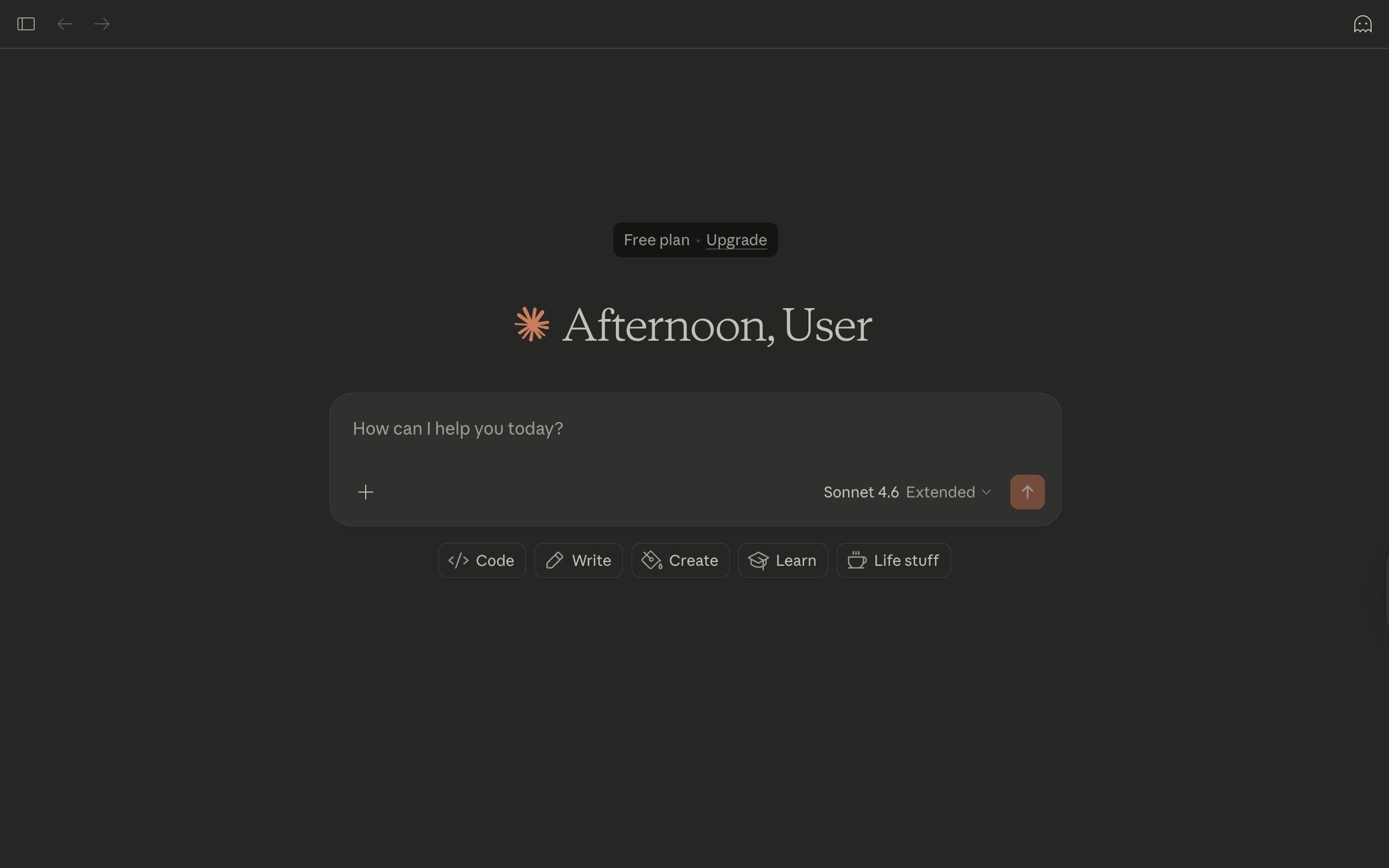
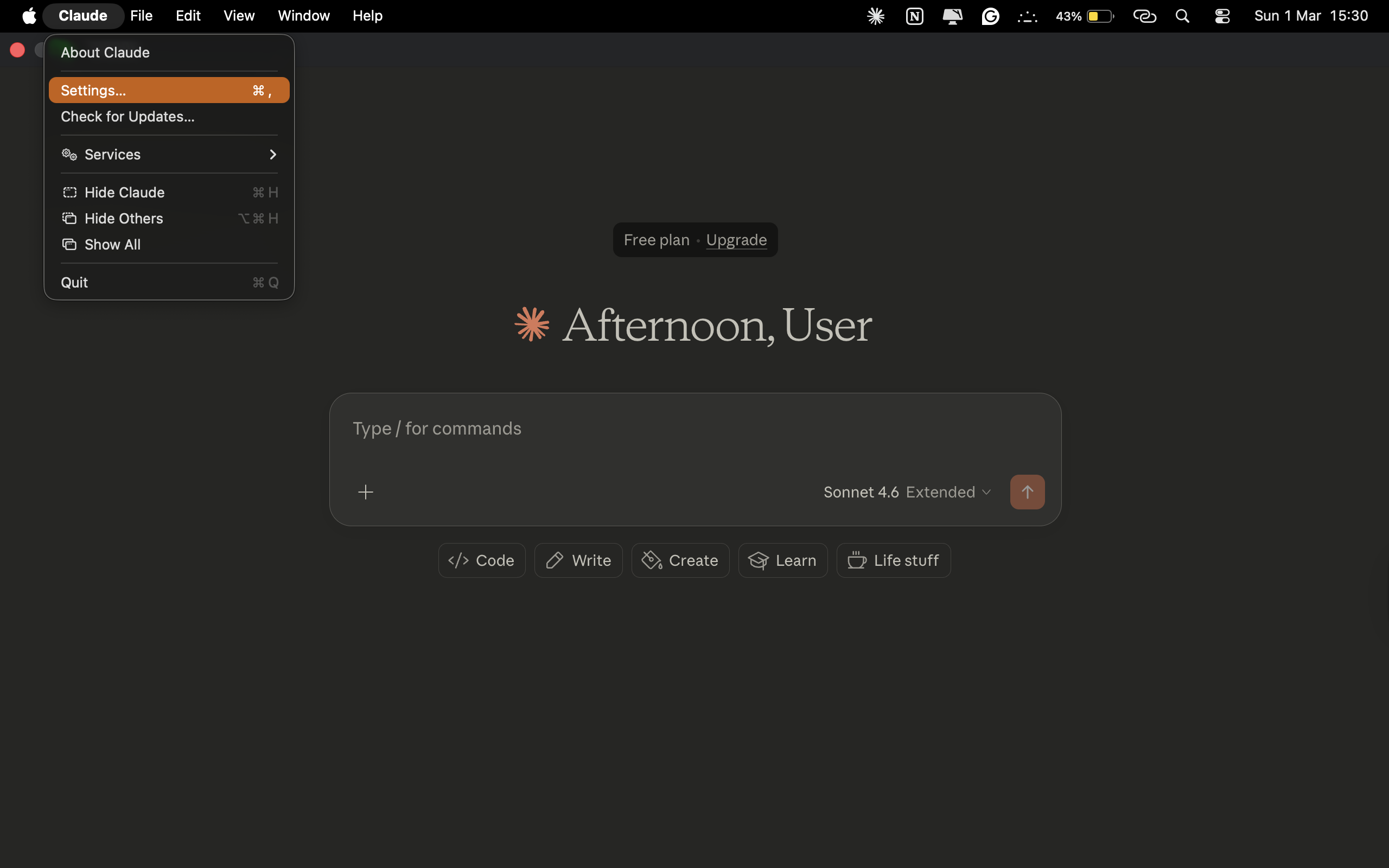
Sign into the application, and select Settings from the top menu.
Click Developer from the sidebar menu to edit the configuration file (claude_desktop_config.json). Add Late to the configuration file as shown below:
{
	"mcpServers": {
		"late": {
			"command": "uvx",
			"args": ["--from", "late-sdk[mcp]", "late-mcp"],
			"env": {
				"LATE_API_KEY": "your_api_key_here"
			}
		}
	}
}
After updating the configuration file, restart the application to enable the Late API integration in Claude Desktop. Once configured, you can publish and schedule social media posts directly from Claude using natural language commands.
If you encounter any issues, refer to the complete documentation or follow the video guide below.
Best Practices for AI Agent Social Media Posting
When building AI agents that publish to social media platforms, following best practices helps ensure reliability and consistency across all APIs or agents. While you can implement these practices manually, unified social media APIs such as Late handle many of these concerns automatically, reducing the complexity of agent development.
Rate limit handling
AI agents should monitor API rate limits and implement retry strategies such as exponential backoff to prevent failed requests and ensure the agent can continue posting reliably without being blocked by the platform. However, unified platforms like Late provide predictable rate-limit headers and centralised handling, reducing the need to implement platform-specific rate-limit logic.
Content validation
AI-generated posts should be validated before sending them to the API. This includes checking character limits, required fields, supported media formats, and platform-specific constraints to prevent rejected requests. Unified APIs can simplify validation by enforcing standardised request formats and automatically adapting content to platform requirements.
Error handling patterns
AI agents should implement structured error handling that detects failures, logs useful information, and retries requests when appropriate. For instance, Late API returns consistent error responses across platforms, making it easier for AI agents to detect and handle failures predictably.
Scheduling vs immediate posting
AI agents should support both scheduled and real-time posting. Scheduling helps distribute posts evenly and avoid rate limits, while immediate posting is useful for time-sensitive actions such as alerts or live updates. Late offers built-in scheduling capabilities, allowing AI agents to manage both scheduled and immediate posts through a single interface.
Conclusion
AI agents require reliable and simple APIs to autonomously post, monitor, and interact across multiple social media platforms. The Late API simplifies multi-platform management by providing a single endpoint, consistent response schemas, and easy authentication, reducing both development and operational overhead.
With its SDKs, AI agent integrations, and unified design, Late API is ideal for AI workflows, supporting seamless integration with agents and LLMs such as Claude, OpenAI, and Google Studio.

Miquel is the founder of Late, building the most reliable social media API for developers. Previously built multiple startups and scaled APIs to millions of requests.
View all articlesLearn more about Late with AI
See what AI assistants say about Late API and this topic