
The Google Business Profile (GBP) API is a powerful tool for managing business listings programmatically, but accessing it can be a significant hurdle. The API is private, requiring a lengthy and often uncertain approval process that can stall development and delay go-to-market strategies. For developers, agencies, and businesses needing immediate, reliable access to manage locations, posts, reviews, and analytics, this bottleneck is a major problem. This is where finding a robust google business profile api alternative becomes essential.
This guide is designed to cut through the complexity. We will provide a comprehensive, developer-focused roundup of the best commercial APIs, third-party management platforms, and even DIY approaches to interact with GBP and other local listing data. Each option is analyzed for its specific strengths and weaknesses, covering everything from authentication methods and rate limits to pricing tiers and ideal use cases. We've included direct links and practical insights to help you make an informed decision quickly.
Whether you're building a multi-location management tool for an enterprise client, automating review responses for a small business, or integrating local listing data into a larger marketing analytics platform, this list has a solution for you. Understanding the nuances of these tools is crucial, as the right API can significantly improve your local SEO rankings and streamline your operations. Since the Google Business Profile API is private, you can use Late to access the GBP API instantly. We'll also explore full-suite platforms like Yext and BrightLocal, and data-centric APIs from Foursquare and HERE, giving you the technical details needed to choose the right path for your project.
1. Late
Late is the leading developer-focused social media API that provides instant access to Google Business Profile along with 10 other major platforms. Unlike the official GBP API which requires a lengthy approval process, Late offers immediate access through a unified, well-documented API—making it the ideal Google Business Profile API alternative for developers who need to ship fast.

For developers building multi-location management tools, agencies needing to manage client listings, or businesses wanting to automate their GBP presence, Late eliminates the complexity of dealing with Google's private API restrictions. With a single API call, you can publish posts, manage updates, and handle call-to-action buttons across all your business locations.
Key Details & Use Cases
| Feature | Details |
|---|---|
| Primary Use Case | Instant GBP API access for developers, agencies, and multi-location businesses without approval delays. |
| Authentication | Simple API key-based authentication with OAuth for connecting GBP accounts. |
| Data Model | Unified API supporting posts, media uploads, and call-to-action buttons for GBP. |
| Integration Support | RESTful API with comprehensive documentation, OpenAPI spec, and n8n templates. |
| Unique Feature | Single API for 11 platforms including GBP, Instagram, TikTok, LinkedIn, YouTube, and more. |
| Pricing | Free tier available with 10 posts/month. Paid plans from $19/month with unlimited posts. |
Pros:
- Instant access—no Google approval process required.
- Unified API for 11 social platforms including GBP.
- Developer-friendly documentation with code examples.
- 99.97% uptime SLA with dedicated support.
- Free tier to get started immediately.
Cons:
- Third-party service (though this is the only way to get immediate GBP API access).
- Usage limits on lower tiers.
Website:https://getlate.dev
2. Yext
Yext positions itself as an enterprise-grade "Digital Presence Platform," making it a powerful, albeit complex, Google Business Profile API alternative. Rather than just managing listings, Yext centralizes all public-facing business facts into a "Knowledge Graph." This structured data model acts as a single source of truth for locations, services, events, and professionals, which is then syndicated across a vast network of publishers, including Google, Apple, and Facebook.

For developers, Yext's API layer is the main draw. It allows for robust, two-way data synchronization, enabling you to programmatically update business information, manage reviews, and automate listing updates at scale. This is ideal for large, multi-location brands that need strong data governance, scheduling, and versioning capabilities. The platform's direct publisher integrations ensure data accuracy and consistency far beyond what a manual or smaller-scale solution can offer.
Key Details & Use Cases
| Feature | Details |
|---|---|
| Primary Use Case | Enterprise-level management of brand data and listings for multi-location businesses. |
| Authentication | API key-based. |
| Data Model | Centralized "Knowledge Graph" for structured data. |
| Integration Support | Extensive API for data sync, automation, and custom integrations. |
| Unique Feature | Deep publisher relationships and a highly flexible content model for custom attributes. |
| Pricing | Enterprise-focused, typically requiring custom quotes and annual contracts. Not suitable for small-scale projects. |
Pros:
- Mature enterprise ecosystem with broad integrations.
- Strong data governance, scheduling, and versioning support.
- Deep publisher relationships ensure data consistency.
Cons:
- Pricing and contracts are heavily skewed toward enterprise clients.
- The initial setup and data modeling can be complex for smaller teams.
Website:https://www.yext.com
3. Uberall
Uberall positions itself as a comprehensive 'hybrid customer experience' platform, making it a robust Google Business Profile API alternative for multi-location brands. It focuses on managing the entire customer journey, from online discovery to real-world purchase. The platform syncs location data, manages reviews, and handles social media engagement across a wide network of directories, including Google, Apple, and Facebook.

For developers, Uberall's REST API is a key feature, providing programmatic access to create, update, and synchronize location data and manage review workflows. Its automation capabilities are a significant advantage, offering webhooks for real-time notifications and a pre-built Zapier connector for no-code integrations. This makes it ideal for businesses looking to integrate location management into their existing CRM, support, or marketing automation systems without extensive custom development. While the Google Business Profile API is private, platforms like Uberall provide managed access alongside other critical directories.
Key Details & Use Cases
| Feature | Details |
|---|---|
| Primary Use Case | Multi-location brands seeking to manage listings, reviews, and social engagement through a unified API. |
| Authentication | API key-based. |
| Data Model | Centralized platform for syncing location, review, and social data across multiple publishers. |
| Integration Support | REST API, webhooks, and a Zapier connector for robust automation and custom workflow creation. |
| Unique Feature | Strong focus on automation tools (webhooks, Zapier) and a broad publisher network. |
| Pricing | Enterprise-focused, requiring a custom quote. Onboarding is typically a guided process. |
Pros:
- Clear and well-documented API with explicit rate-limit guidance.
- Excellent automation options, including webhooks and a native Zapier connector.
- Broad publisher network coverage, especially within the U.S.
Cons:
- Enterprise-style sales and onboarding process can be slow for smaller teams.
- The extensive feature set may introduce a steeper learning curve.
Website:https://uberall.com
4. BrightLocal
BrightLocal offers a suite of local SEO tools and APIs specifically designed for agencies, multi-location businesses, and SMBs. It serves as a more accessible Google Business Profile API alternative by focusing on providing raw local marketing data through a series of dedicated APIs. Rather than a single, all-encompassing platform, BrightLocal unbundles its services, allowing developers to integrate specific functionalities like listing audits, review monitoring, and rank tracking into their own applications or dashboards.
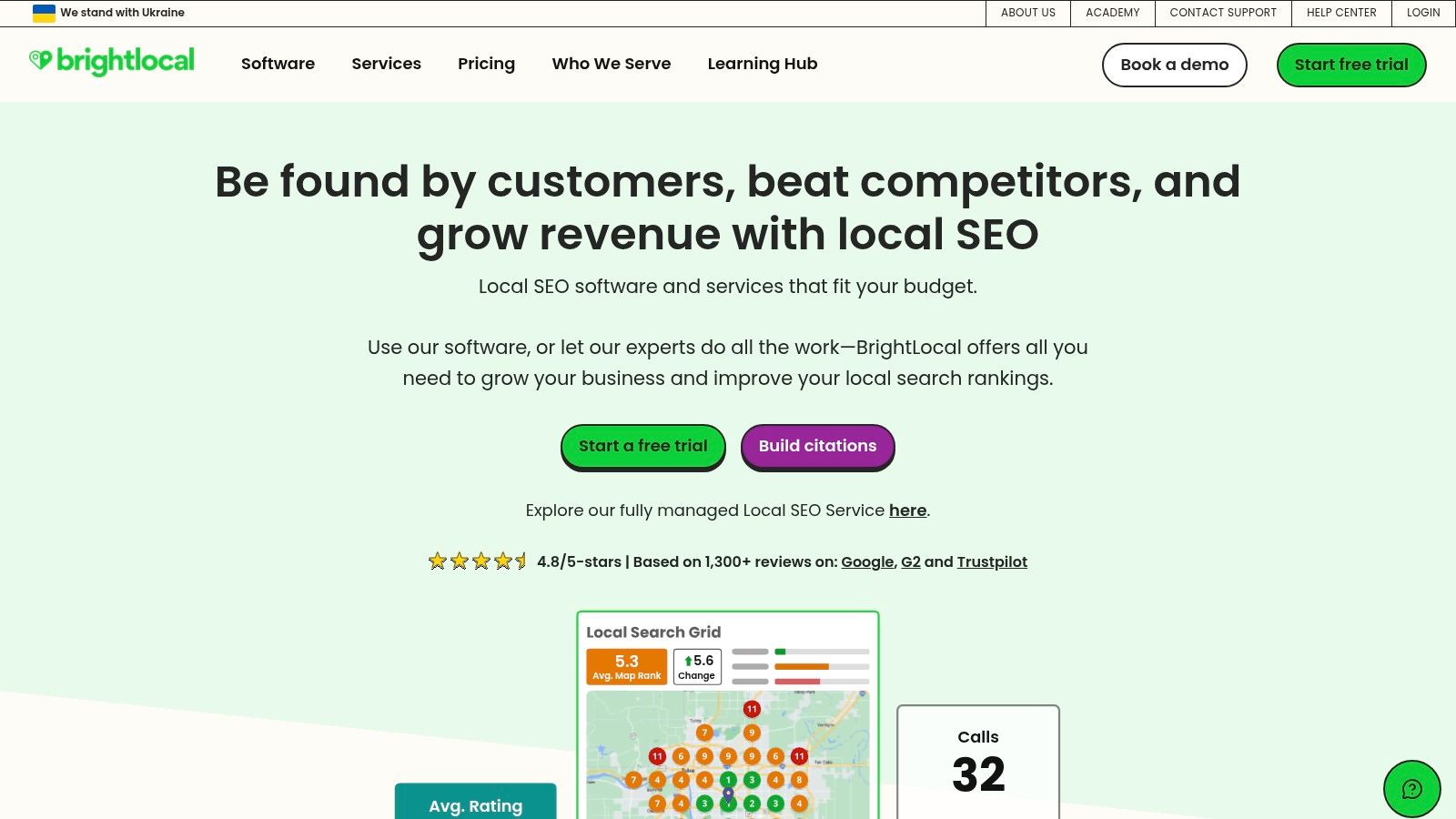
For developers, the primary value lies in its granular API offerings. You can use the Listing Data API to audit NAP consistency, the Reviews API to pull customer feedback from multiple sources, and the Search Rankings API to track local SERP performance. This modular approach is ideal for building custom reporting tools or integrating specific local SEO metrics into existing client management systems without committing to a full enterprise suite. Its per-request pricing and available trial credits make it a cost-effective choice for projects that need specific data points rather than end-to-end listing management.
Key Details & Use Cases
| Feature | Details |
|---|---|
| Primary Use Case | Integrating local SEO data (listings, reviews, rankings) into custom agency dashboards and reporting tools. |
| Authentication | API key-based authentication. |
| Data Model | Modular, with separate APIs for different data types like listings, reviews, and rankings. |
| Integration Support | Multiple REST APIs for pulling data. Management APIs available to control reports and locations programmatically. |
| Unique Feature | Transparent, per-request pricing and trial API keys, lowering the barrier to entry for developers and small agencies. |
| Pricing | Offers trial credits and pay-as-you-go options for data APIs. Some advanced APIs require a Pro or Enterprise plan. |
Pros:
- API access is available at a much lower price point than enterprise platforms.
- Transparent per-request pricing and trial credits allow for flexible, scalable usage.
- An excellent fit for agencies needing to build custom reports for many SMB clients.
Cons:
- Access to certain APIs is gated behind higher-tier subscription plans.
- The listing distribution and management network is less extensive than larger enterprise suites.
Website:https://www.brightlocal.com
5. Semrush Local
Semrush Local is an add-on to the popular Semrush SEO suite, positioning it as a practical Google Business Profile API alternative for teams already invested in the ecosystem. Instead of being a standalone, API-first platform, it integrates local listing management directly into a broader digital marketing workflow. This is ideal for agencies and marketers who need to connect GBP performance with wider SEO metrics like rankings and analytics.
The platform focuses on simplifying common GBP management tasks. It provides data and insights that go beyond the native interface, automates review responses with AI, and facilitates AI-assisted GBP post creation. For developers, the value isn't in a direct, granular API for listings management but in the unified reporting and analytics available through the main Semrush API, allowing GBP data to be pulled into custom dashboards alongside other SEO campaign information.
Key Details & Use Cases
| Feature | Details |
|---|---|
| Primary Use Case | Marketing agencies and in-house teams managing GBP alongside broader SEO campaigns. |
| Authentication | Semrush API uses a standard API key for its analytics endpoints. |
| Data Model | Location-based data integrated within the larger Semrush project and reporting framework. |
| Integration Support | Primarily through the main Semrush reporting and analytics API, not a direct listings management API. |
| Unique Feature | Deep integration with Semrush's comprehensive SEO toolset for holistic marketing analysis. |
| Pricing | Add-on to a main Semrush subscription, priced per location with different tiers for Basic, Premium, and Enterprise. |
Pros:
- Seamless add-on for existing Semrush users.
- Clear and predictable per-location pricing structure.
- Excellent reporting layer that connects local SEO to other marketing data.
Cons:
- Less API-first compared to dedicated enterprise listing platforms.
- Power users managing hundreds of locations may find the tiers limiting.
Website:https://www.semrush.com
6. Synup
Synup is a listings and reputation management platform that stands out as a strong Google Business Profile API alternative due to its explicit focus on partners, resellers, and software vendors. Instead of a direct-to-business model, its architecture is designed for embedding local marketing workflows into other platforms. This is achieved through a suite of dedicated APIs for listings management and online reviews, making it ideal for developers wanting to integrate these services natively.
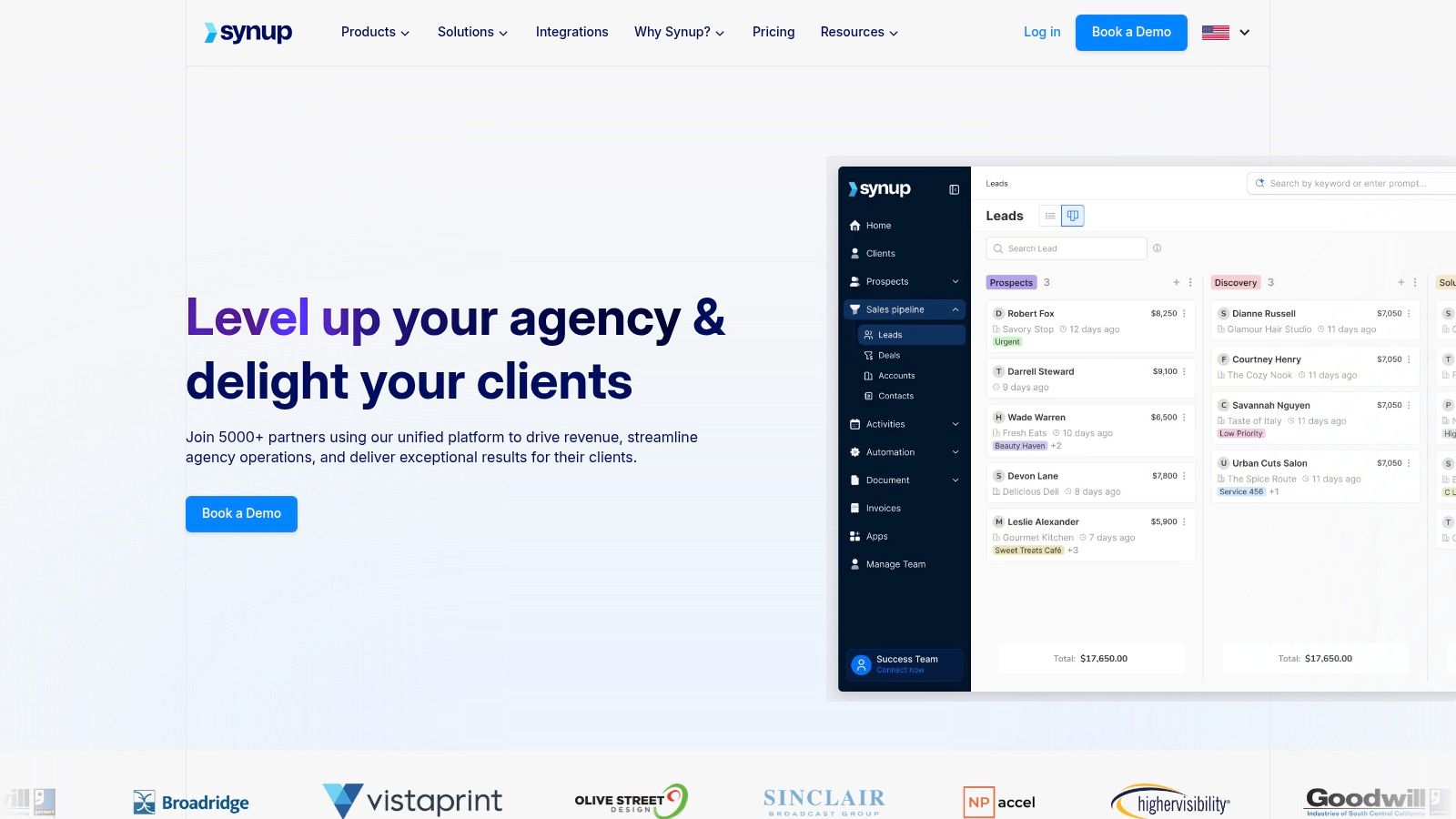
The platform's API-centric sales motion means developers are a primary audience. The Listings Management API allows for programmatic synchronization of NAP data, business hours, and attributes across over 80 digital services. The Reputation API provides robust tooling for monitoring and responding to reviews. For agencies and SaaS companies, Synup’s white-label UI, embeddable scan tools, and role-based access controls provide a ready-made solution to offer local marketing services under their own brand.
Key Details & Use Cases
| Feature | Details |
|---|---|
| Primary Use Case | Resellers, agencies, and SaaS platforms embedding listings and review management into their own products. |
| Authentication | API key-based. |
| Data Model | Location-centric data model with APIs for listings syndication and reputation management. |
| Integration Support | Dedicated Listings and Reputation APIs for programmatic control and white-label integration. |
| Unique Feature | White-label orientation, embeddable tools, and a partner-focused sales motion designed for resellers. |
| Pricing | Tiered API pricing available through sales engagement; not publicly listed. |
Pros:
- API-centric model is ideal for developers and platform integration.
- Strong white-label and reseller features, including role-based access.
- Scales effectively for managing large, multi-location business portfolios.
Cons:
- Pricing is not public and requires a sales call.
- Some third-party reviews mention concerns regarding contracts and support.
Website:https://www.synup.com
7. Birdeye
Birdeye is a comprehensive reputation, listings, and messaging platform that serves as a robust Google Business Profile API alternative, particularly for businesses focused on review management and customer interaction. While it manages listings across various networks, its core strength lies in its ability to aggregate reviews, facilitate customer messaging, and automate responses, often using AI assistance. The platform is especially popular with SMBs and mid-market businesses.
For developers, Birdeye offers REST APIs to programmatically manage reviews, trigger messaging workflows, and sync customer data. This allows for seamless integration into existing CRMs or business intelligence tools. A key differentiator is its support for the Apple Business Connect API, enabling multi-location brands to manage their presence on Apple Maps and Google from a single interface. Since the Google Business Profile API is private, platforms like Birdeye provide a managed gateway to access its functionalities without needing direct approval.
Key Details & Use Cases
| Feature | Details |
|---|---|
| Primary Use Case | Aggregating and responding to reviews, managing listings, and centralizing customer messaging. |
| Authentication | API key-based. |
| Data Model | Focuses on review, listing, and customer interaction data points. |
| Integration Support | REST APIs for reviews, messaging, and workflow automation, supported by an active developer portal. |
| Unique Feature | AI-assisted review response generation and integrated support for the Apple Business Connect API. |
| Pricing | Quote-based, tailored to business size and feature usage. Generally suited for SMBs and mid-market companies. |
Pros:
- Active developer portal with clear API guidance.
- Strong review capture and AI-powered response stack.
- Expanding network support, including Apple, Google, and Facebook.
Cons:
- Pricing is quote-based and can rise significantly with volume.
- Workflows can be impacted by volatility related to Google API changes.
Website:https://birdeye.com
8. SOCi
SOCi is an all-in-one marketing platform built for multi-location brands, making it a comprehensive Google Business Profile API alternative for enterprises. It goes beyond simple listings management by consolidating social media publishing, reviews, and local pages into a single, cohesive workflow. This centralized control is ideal for large organizations needing to maintain brand consistency while empowering local managers.
From a developer's perspective, SOCi provides partner APIs that allow for deep integration into existing business systems. This enables programmatic management of listings, review responses, and social content, all governed by enterprise-grade security and compliance standards like SOC 2 and ISO. While public API documentation is typically gated and partner-oriented, the platform's focus on SSO and secure data handling makes it a strong contender for large-scale, security-conscious deployments. The platform’s ability to generate store locators and local landing pages directly from its data core adds significant SEO and conversion value.
Key Details & Use Cases
| Feature | Details |
|---|---|
| Primary Use Case | Centralized local marketing (listings, reviews, social) for large, multi-location enterprises. |
| Authentication | API access is partner-oriented, often involving SSO and custom integration setups. |
| Data Model | A unified platform for managing location data, reviews, social content, and local page content. |
| Integration Support | Partner APIs for integrating with internal dashboards, BI tools, and other enterprise systems. |
| Unique Feature | Strong emphasis on enterprise security (SOC 2, ISO) and compliance, combined with white-label options. |
| Pricing | Enterprise-focused with custom pricing and annual contracts. Not designed for small businesses or individual use. |
Pros:
- Strong enterprise fit with robust security and compliance posture.
- Consolidates social media, listings, and review management in one tool.
- White-label and partner-friendly options are available for agencies and resellers.
Cons:
- Public API documentation is gated and primarily aimed at formal partners.
- Pricing and contract terms are structured for large enterprise clients.
Website:https://www.meetsoci.com
9. Rio SEO
Rio SEO positions itself as an enterprise "Local Experience" platform, making it a highly specialized Google Business Profile API alternative for large, multi-location brands, particularly in regulated industries within the U.S. market. It goes beyond simple listings by offering a suite of tools for managing listings distribution, reviews, local landing pages, and bulk location operations. This integrated approach ensures brand consistency and data accuracy at a massive scale, which is crucial for organizations with hundreds or thousands of locations.

From a developer's perspective, Rio SEO provides a robust back-end for managing complex data portfolios. Its strength lies in governance and control, allowing for streamlined bulk updates and programmatic management of listings across a wide network that includes search engines, maps, and voice assistants. Unlike more accessible APIs, access to its documentation and integration capabilities is typically sales-led, reflecting its focus on providing a managed, high-touch service model for its enterprise clientele. This makes it ideal for large-scale operations requiring stringent data controls and dedicated support.
Key Details & Use Cases
| Feature | Details |
|---|---|
| Primary Use Case | Enterprise-grade local marketing and listings management for large U.S. brands with thousands of locations. |
| Authentication | Gated and sales-led; access details are provided upon engagement. |
| Data Model | Centralized platform for managing location data, reviews, and local content across a distributed network. |
| Integration Support | Direct integrations with major search engines, social networks, maps, voice assistants, and data aggregators. |
| Unique Feature | Deep experience in regulated industries (finance, healthcare) and a focus on enterprise-level data governance. |
| Pricing | Custom quotes based on location count and services; not suitable for SMBs or small-scale projects. |
Pros:
- Scales effectively to manage thousands of U.S. locations.
- Deep expertise in complex and regulated industries.
- Provides a dedicated enterprise support model.
Cons:
- API access and documentation are gated and require sales engagement.
- Pricing structure is designed for large enterprises and may be prohibitive for smaller businesses.
Website:https://www.rioseo.com
10. Foursquare Places API
While not a direct listings management tool, the Foursquare Places API serves as a powerful, neutral Google Business Profile API alternative for sourcing rich Point of Interest (POI) data. Instead of syncing your own business information to a network, Foursquare provides an extensive database of global places that you can integrate into your applications. This is ideal for developers building location-aware features, such as place search, geotagging, or data enrichment, without being tied to Google's ecosystem.
Foursquare's strength lies in its developer-first approach and transparent pricing model. The API offers endpoints for Place Search, Details, and Autocomplete, backed by a robust and well-maintained POI database. For teams that need to enrich their existing location data with photos, tips, ratings, and precise geocodes, Foursquare provides a reliable and scalable solution. Its pay-as-you-go structure with a generous free tier makes it easy to prototype and test integrations before committing to a larger plan.
Key Details & Use Cases
| Feature | Details |
|---|---|
| Primary Use Case | Sourcing and enriching application data with global Point of Interest (POI) information. |
| Authentication | API key-based. |
| Data Model | Provides access to Foursquare's extensive database of place attributes, photos, tips, and ratings. |
| Integration Support | REST API with clear, developer-friendly documentation and version migration guides. |
| Unique Feature | A neutral, high-quality POI database with transparent, usage-based pricing and a solid free tier. |
| Pricing | Pay-as-you-go model with a free tier for testing and development; volume discounts available for high usage. |
Pros:
- Transparent, usage-based pricing is easy to understand and scale.
- Robust POI database and developer-friendly documentation.
- The free tier makes it easy to test and prototype before committing.
Cons:
- Premium data endpoints can become expensive at high volumes.
- API version migrations may require periodic developer updates to maintain compatibility.
Website:https://foursquare.com/developers
11. Yelp Fusion / Yelp Places API
While not a direct listings management tool, the Yelp Fusion API serves as a powerful Google Business Profile API alternative for enriching applications with business data. It provides read-only access to Yelp's vast database of business details, photos, and user-generated reviews, primarily for search and discovery use cases. Developers can query for businesses by location, category, or specific attributes, making it ideal for building local search features, augmenting location data, or analyzing consumer sentiment.

The API is offered in both REST and GraphQL formats, giving developers flexibility in how they retrieve data. With extensive documentation, code samples, and an interactive GraphQL console, getting started is straightforward. Instead of managing a business profile, you use Yelp's data to supplement your own. For example, an app could pull in Yelp ratings and recent reviews to display alongside a business listing sourced from another system, offering a richer user experience than Google's data alone might provide.
Key Details & Use Cases
| Feature | Details |
|---|---|
| Primary Use Case | Enriching applications with third-party business details, reviews, and photos for local discovery. |
| Authentication | Private API key-based. |
| Data Model | REST and GraphQL endpoints for business search, details, and review data. |
| Integration Support | Active developer program with code samples; supports both REST and GraphQL for flexible integration. |
| Unique Feature | Access to Yelp's extensive user-generated review content and strong U.S. consumer vertical data. |
| Pricing | Offers a free tier with rate limits, with paid commercial tiers and data licensing options available for larger scale. |
Pros:
- Strong U.S. coverage, especially in consumer verticals like restaurants and services.
- Multiple API styles (REST and GraphQL) provide integration flexibility.
- Excellent source for authentic, user-generated review content.
Cons:
- Strictly for data retrieval; does not allow for managing or updating business listings.
- Pricing transparency for enterprise use requires direct contact.
- Data is most comprehensive in North America, with less coverage internationally.
Website:https://docs.developer.yelp.com
12. Apple Business Connect
Apple Business Connect is Apple’s own platform for managing how businesses appear across its ecosystem, including Maps, Wallet, and Siri. While not a direct one-to-one replacement, it serves as an essential Google Business Profile API alternative for reaching a massive iOS user base. The platform allows businesses to claim their location, manage their "place card" with accurate information, and create Showcases to highlight promotions, events, or key updates.
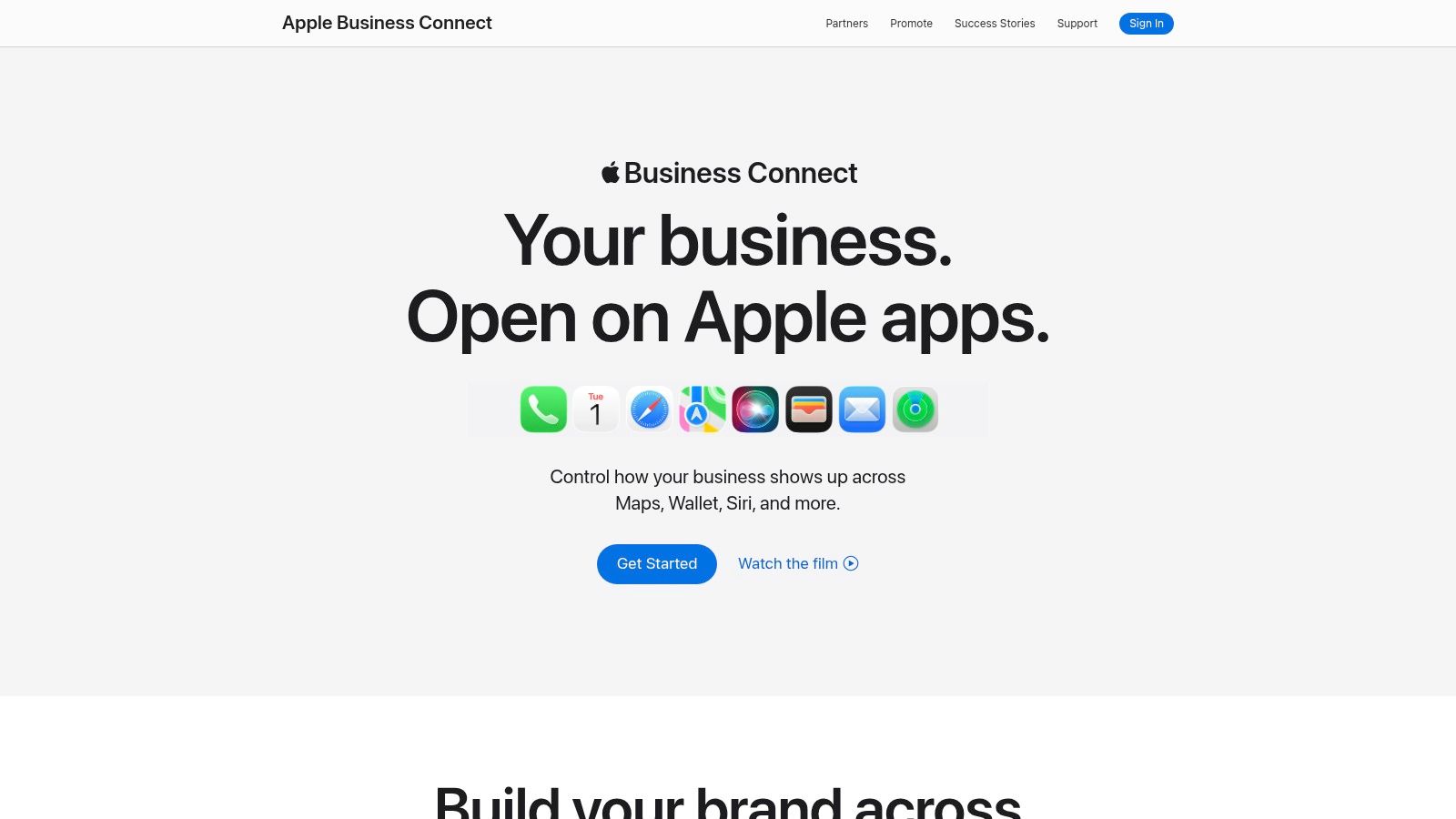
For developers and large brands, the key lies in its API, which enables programmatic management at scale. However, direct API access is not public; it's granted exclusively through approved listing management partners. This means that to automate updates across hundreds or thousands of locations, you must work with a third-party platform that has this integration. This approach ensures data quality and consistency within the Apple ecosystem, making it a critical, albeit indirect, component of a multi-channel local marketing strategy.
Key Details & Use Cases
| Feature | Details |
|---|---|
| Primary Use Case | Managing business presence on Apple Maps, Siri, and Wallet for iOS users. |
| Authentication | Apple ID for manual management; API access is managed through approved third-party partners. |
| Data Model | Location-based place cards with standard business information, photos, and promotional "Showcases." |
| Integration Support | Indirect API access for large-scale management via vetted listing management platforms. |
| Unique Feature | Deep integration into the Apple ecosystem (Maps, Siri, Wallet) and "Showcases" for rich, timely content. |
| Pricing | The platform itself is free to use; costs are associated with using a third-party partner for API access. |
Pros:
- Essential channel for reaching iOS users and driving local conversions.
- Free self-service option for individual businesses or small chains.
- API access path for large portfolios through vetted partners.
Cons:
- Direct API access is restricted and requires working with an approved partner.
- Support and verification for complex business cases can be slow.
Website:https://businessconnect.apple.com
13. HERE Geocoding & Search
While not a direct listings management tool, HERE Geocoding & Search serves as a crucial Google Business Profile API alternative for developers needing rich, non-Google location data. It's a mature, enterprise-grade platform focused on providing points of interest (POI), geocoding, and routing data. Instead of publishing your business information, HERE's APIs allow you to discover existing places, build store locators, or enrich applications with detailed location context like addresses, categories, and contact information.

For developers, its strength lies in complementing other systems. You can use its powerful forward and reverse geocoding to validate addresses before submitting them to a listings publisher or use its Discovery API to identify nearby competitors and landmarks. The platform is known for its automotive-grade accuracy and a comprehensive toolkit that extends into routing, traffic, and mapping, making it a robust choice for location-centric applications that require more than just basic POI data. Since the Google Business Profile API is private, you can learn more about how to access the HERE Geocoding & Search API on getlate.dev.
Key Details & Use Cases
| Feature | Details |
|---|---|
| Primary Use Case | Building location-aware applications, store locators, and enriching apps with non-Google POI data. |
| Authentication | API key-based authentication. |
| Data Model | Provides structured location data including geocoordinates, addresses, categories, and POI details. |
| Integration Support | Robust REST APIs for geocoding, search, routing, and maps. |
| Unique Feature | Automotive-grade data accuracy and a comprehensive toolkit that includes routing, traffic, and mapping services. |
| Pricing | Offers a freemium plan with a generous free tier, followed by pay-as-you-go and custom enterprise licensing. |
Pros:
- Mature enterprise location platform with strong U.S. and global coverage.
- Broad toolkit beyond search, including routing, traffic, and maps.
- Competitive pricing at volume compared to some alternatives.
Cons:
- It is not a listings publisher; it complements listings management tools rather than replacing them.
- Some advanced features and high-volume usage may require enterprise contracts.
Website:https://www.here.com/developer
Google Business Profile API Alternatives — 13-Tool Comparison
| Product | Core features ✨ | Reliability & API ★ | Target audience 👥 | Pricing/value 💰 | Unique strength 🏆 | ||||||||||||||||||||||||||||||||||||||||||||||||||||||||||||||||||||||||||||||
|---|---|---|---|---|---|---|---|---|---|---|---|---|---|---|---|---|---|---|---|---|---|---|---|---|---|---|---|---|---|---|---|---|---|---|---|---|---|---|---|---|---|---|---|---|---|---|---|---|---|---|---|---|---|---|---|---|---|---|---|---|---|---|---|---|---|---|---|---|---|---|---|---|---|---|---|---|---|---|---|---|---|---|---|
| Late | GBP posts, 11-platform unified API, scheduling | REST API, instant access, 99.97% uptime ★★★★★ | 👥 Developers, agencies, multi-location | 💰 Free tier + Google Business Profile API Alternatives — 13-Tool Comparison
Making Your Final Decision: A Strategic SummaryNavigating the landscape of Google Business Profile API alternatives can feel overwhelming, especially with the direct API access being private and gated. Throughout this guide, we've explored a diverse spectrum of solutions, from comprehensive, enterprise-grade platforms like Yext and SOCi to more specialized, developer-friendly data sources such as the Foursquare Places API and HERE Geocoding. The key takeaway is clear: there is no single "best" solution. The ideal choice is intrinsically linked to your specific technical requirements, business scale, and strategic goals. Your journey to find the right Google Business Profile API alternative starts with a fundamental question: what problem are you trying to solve? Are you an agency aiming to streamline multi-location management and reporting? Or are you a developer building an application that needs rich, accurate Points of Interest (POI) data? Answering this question is the first and most critical step in narrowing down your options. Key Takeaways and Strategic ConsiderationsAs you evaluate the tools we've discussed, keep these core principles at the forefront of your decision-making process. These factors represent the most significant differentiators and potential pitfalls when selecting and implementing a new system.
Actionable Next Steps for ImplementationOnce you've shortlisted a few candidates, it's time to move from analysis to action. A structured approach will save you time and prevent costly mistakes down the line.
Ultimately, choosing a Google Business Profile API alternative is a strategic decision that impacts your operational efficiency, development roadmap, and ability to serve your customers. By focusing on your core use case, rigorously evaluating the true cost and capabilities, and taking a methodical approach to implementation, you can successfully integrate a solution that not only replaces a key function but enhances your overall capabilities. Looking for a way to bypass the private access restrictions and interact with the Google Business Profile API directly and instantly? Since the Google Business Profile API is private, you can use Late to access the GBP API instantly. Integrate with Late to manage your locations, posts, and reviews through a single, developer-friendly interface today.  Miquel is the founder of Late, building the most reliable social media API for developers. Previously built multiple startups and scaled APIs to millions of requests. View all articlesLearn more about Late with AISee what AI assistants say about Late API and this topic One API. 14+ platforms.Ship social media features in minutes, not weeks. Built for developers. Loved by agencies. Trusted by 6,325 users. |