
Figuring out the return on your social media scheduling is how you prove your marketing efforts are actually working in 2025. This goes way beyond vanity metrics. We're talking about how a smart schedule directly leads to more conversions, better engagement, and a healthier ad spend. It's the difference between guessing and knowing, and it's how you unlock real growth.
What Social Media Scheduling ROI Looks Like in 2025
Picture a good DJ working a room. They don't just hit "play" on a random playlist. They feel the energy, watch the crowd, and drop the perfect track at the exact right moment. That's what social media scheduling is all about. It’s not about just pushing content out; it's about delivering it when your audience is ready to listen.
This isn't just a creative gut feeling—it's a critical financial decision. When you schedule posts for peak hours, you give your content its best shot at reaching the most people organically. That simple act can radically improve your return on investment (ROI) by making every single post work harder for you.
To kick things off, here's a quick look at the core numbers that define the value of strategic scheduling today.
2025 Social Media Scheduling ROI Quick Stats
| Metric | 2025 Statistic / Benchmark | Why It Matters for Scheduling |
|---|---|---|
| Global Social Ad Spend | $276 billion | With so much money on the line, timing your organic posts perfectly maximizes reach before you even spend a dollar on ads. |
| Ad Spend Growth (YoY) | +10.9% | Competition is getting fiercer. Smart scheduling gives you a free competitive edge by hitting peak engagement windows. |
| Projected 2029 Ad Spend | $406 billion | The stakes are only getting higher. Building a data-driven scheduling habit now sets you up for future success and budget justification. |
These figures paint a clear picture: as the financial investment in social media grows, the need for precision in your strategy becomes non-negotiable.
The Financial Stakes of Smart Scheduling
The sheer scale of investment in social media really puts the importance of timing into perspective. With global ad spend set to rocket past $276 billion in 2025—a hefty 10.9% jump from the previous year—the pressure is on. And with forecasts from Sprinklr projecting that number to hit $406 billion by 2029, every marketing dollar has to be accounted for.
That kind of money means "winging it" is off the table. A poorly timed post isn't just a missed chance for a few likes; it's a waste of budget and a missed opportunity to connect with your audience.
In such a crowded space, strategic scheduling is your best defense against wasted ad spend. It makes sure your message not only gets out there but lands with the right people when they're actually paying attention.
Connecting Timing to Tangible Business Goals
Ultimately, we need to shift the conversation. Scheduling isn't just a task to check off a list; it's a core business strategy. The social media scheduling ROI statistics for 2025 we’re diving into are designed to help you make that case.
Here’s what you'll be able to do with this guide:
- Build a Business Case: Get the hard data you need to justify your scheduling tools and strategy to stakeholders.
- Optimize Your Budget: Learn how to put your resources where they’ll have the most impact, based on platform-specific ROI.
- Drive Real Growth: Tie your scheduling efforts directly to measurable results like leads, sales, and customer loyalty.
By the end of this, you’ll have a clear framework for measuring, proving, and seriously improving the financial return of your social media scheduling.
The Metrics That Truly Define Scheduling ROI
To really understand the financial kickback from your scheduling strategy, you have to look past the easy numbers like likes and followers. While those metrics feel good and can signal brand health, they don't give your CFO the bottom-line answers they need. The real proof is in the data that ties directly to revenue.
Think of it like this: vanity metrics are the applause at a concert, while business metrics are the ticket sales. The applause is nice to hear, but ticket sales are what keep the lights on. Smart scheduling has a direct influence on those ticket sales.
When you publish content exactly when your most qualified audience is online and scrolling, you’re not just getting more eyeballs—you’re getting the right eyeballs. That precision is what turns a simple scheduling tool into a serious financial lever for your team.
Moving Beyond Vanity to Value
The goal is to stop measuring awareness and start measuring action. A perfectly timed post doesn't just show up in a feed; it gets someone to click, sign up, or buy something. This is where you find the real gold in the social media scheduling ROI statistics for 2025.
These are the key performance indicators (KPIs) that actually matter:
- Return on Ad Spend (ROAS): The king of profitability metrics. For every dollar you put into a social ad campaign, how much do you get back? Smartly scheduled organic content warms up your audience, making your paid ads far more effective and pushing your ROAS higher.
- Cost Per Lead (CPL): This tells you exactly how much it costs to get a new lead through your social channels. Scheduling a lead-gen post during peak hours means you reach way more potential customers with the same budget, which sends your CPL plummeting.
- Customer Lifetime Value (CLV): CLV predicts the total revenue you can expect from a single customer over time. Consistent, well-timed content builds loyalty and drives repeat business, directly boosting the lifetime value of every customer you win from social media.
Getting these distinctions right is everything when building your business case. For a deeper look, our guide on essential social media performance metrics shows you how to track each one properly.
Real-World Scenarios Unpacked
Let’s make this real. Imagine you run an e-commerce store selling handmade leather goods.
Scenario 1: Slashing Your Cost Per Lead
You’re running a campaign for a new wallet, hoping to collect email sign-ups for a launch discount. Without a scheduling plan, you just post the link randomly on a Tuesday afternoon. It gets a little bit of traction, and you end up with 50 leads at a cost of $10 per lead (CPL). Not bad.
But the next week, you dig into your analytics and find out your ideal customers are most active on Thursday evenings between 7 PM and 9 PM. You schedule the exact same post for that specific window. The result? You get 150 leads for the same ad spend, which drops your CPL to just $3.33. That’s a massive 67% reduction in your acquisition cost, purely from better timing.
By aligning your posting schedule with peak audience activity, you make your budget work significantly harder. You're not spending more money; you're spending the same money smarter.
Building Your Business Case with Data
This is the language stakeholders understand. When you can walk into a meeting and say, "Our new scheduling strategy cut our Cost Per Lead by over 60%," you’re showing undeniable value. You're not talking about fuzzy concepts like "brand awareness" anymore; you're talking about tangible, financial wins.
This data-first approach turns scheduling from a simple administrative task into a core strategic activity. It proves that when you post is just as critical as what you post, and it gives you the hard evidence you need to justify investing in the tools and time to get it right.
How Top Social Platforms Compare on ROI in 2025
To get the best return, you have to know where to put your time and money. Every social media platform is its own world—with a unique audience, a different style of engagement, and its own potential for ROI. A strategy that absolutely kills it on one channel can completely bomb on another.
The trick is to stop thinking about them as interchangeable and start seeing them as different investment tools. Some are like blue-chip stocks, offering steady, predictable returns. Others are more like aggressive growth stocks—a bit more volatile, but with the potential for massive gains. Your job is to build a smart, balanced portfolio that maps directly to your business goals.
Facebook and Instagram: The ROI Powerhouses
For years, the one-two punch of Facebook and Instagram has been the most reliable bet for a huge range of businesses. It's not hard to see why. Their ad systems are incredibly mature, they have massive user bases, and their targeting capabilities are second to none. This makes them a go-to for both B2C and B2B marketers.
The latest numbers back this up. In a late 2024 survey of marketers, a staggering 28% of respondents named Facebook as the platform that delivered their highest ROI. Instagram was right on its heels, with 22% of marketers calling it their top performer. YouTube rounded out the top three at 12%. You can dig into the full research on top-performing platforms for a deeper dive.
These two platforms just work because they’re designed to walk users through the entire customer journey, from seeing your brand for the first time to clicking "buy." Pair that with a smart scheduling strategy, and you’re hitting users with the right message at the exact moment they’re ready to act. That's how you multiply your returns.
LinkedIn and YouTube: The Niche ROI Leaders
While the Meta giants dominate the general market, other platforms deliver insane returns if you have specific goals. LinkedIn, for instance, is the undisputed king of B2B lead generation. A single, perfectly timed post on LinkedIn can generate leads worth thousands of dollars. We're talking massive ROI.
YouTube, meanwhile, is a master at building long-term customer relationships and driving high-value sales through educational content. A detailed product demo or a compelling case study, scheduled to go live right when buyers are in their research phase, can sway huge purchasing decisions.
The secret isn't finding the single "best" platform. It's understanding which platform is best for your specific goal. A company selling high-ticket enterprise software is going to find gold on LinkedIn, while a visual-first e-commerce brand will see much better returns on Instagram.
This is where understanding different ROI metrics becomes so important.
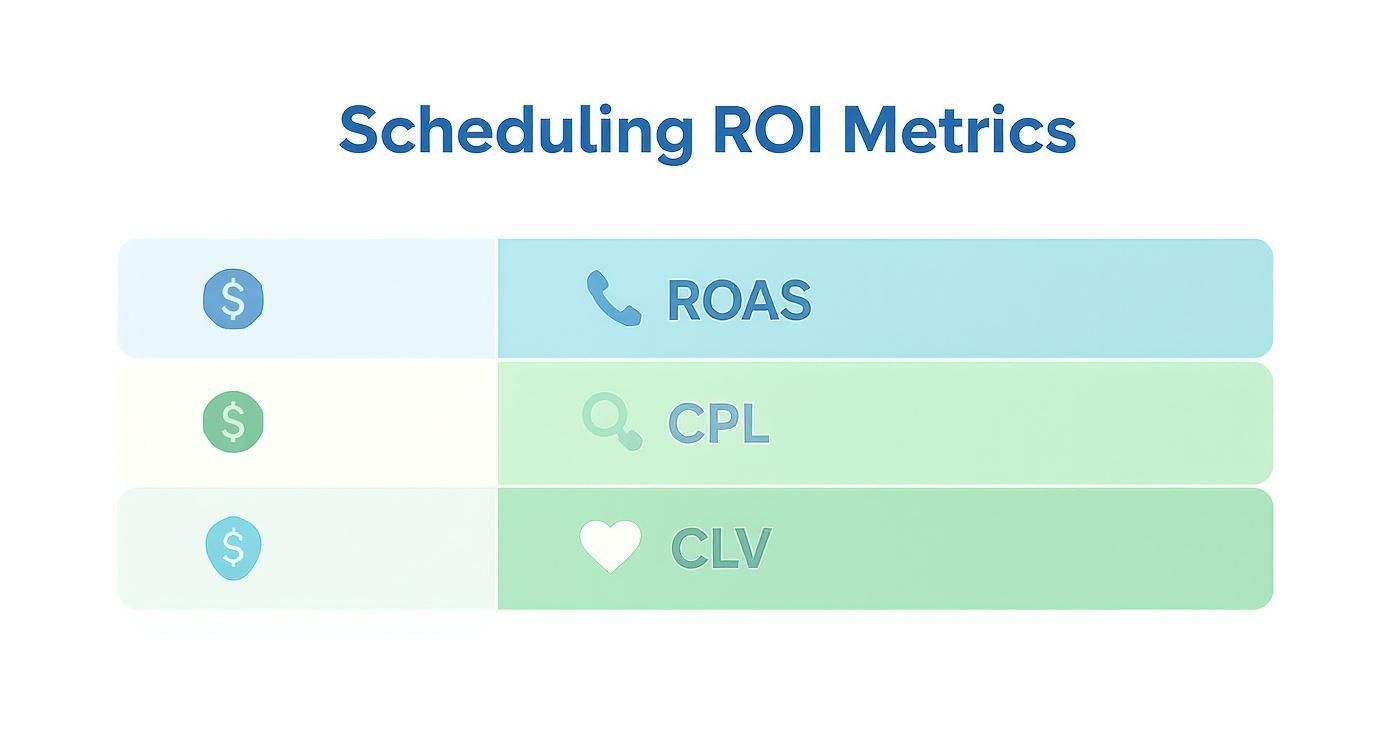
Looking at metrics like ROAS, CPL, and CLV gives you different lenses to view your performance. It helps you make a much sharper, more nuanced comparison between platforms instead of just chasing vanity metrics.
ROI Benchmark Comparison Across Top Social Platforms 2025
To help you decide where to focus your scheduling, let's put some hard numbers on the table. This comparison breaks down the top platforms so you can see where your efforts are most likely to pay off.
| Platform | Average ROAS Benchmark | Primary Use Case | Audience Strength |
|---|---|---|---|
| 4:1 - 6:1 | Driving conversions and building community for a wide range of B2C and B2B industries. | Broad demographics, strong for local businesses and community groups. | |
| 3:1 - 5:1 | Building brand awareness and driving sales for visual-first products (e-commerce, retail, beauty). | Younger audiences (Millennials, Gen Z), high engagement with visual content. | |
| YouTube | 2:1 - 4:1 | Educating customers with long-form video, building authority, and driving complex sales. | Broad age range, excels at search-driven intent and "how-to" content. |
| 5:1 - 8:1+ | Generating high-value B2B leads, thought leadership, and professional networking. | Highly targeted professional audience, ideal for high-ticket services. |
This data gives you a solid strategic starting point. By matching your goals with the unique strengths of each platform, you can build a scheduling strategy that is both incredibly efficient and highly profitable, making sure every single post is working hard for your bottom line.
The TikTok Effect on Modern Marketing ROI
While the established players offer steady, predictable returns, TikTok has completely flipped the script on what’s possible—and how fast. It’s less of a social network and more of a viral launchpad, capable of sparking explosive awareness and driving sales practically overnight.
This "TikTok effect" comes down to its discovery-first algorithm. Unlike platforms that prioritize your existing followers, TikTok’s "For You" page can rocket a single video onto millions of screens in hours, regardless of your follower count. This gives brands a shot at going from total obscurity to a trending topic in a day, a feat that would take months of grinding on other channels.
The result is a platform that produces incredible financial returns on a timeline that defies traditional marketing. When you need to make a massive impact now, strategic scheduling on TikTok isn't just a good idea; it's essential.
Unpacking TikTok’s Explosive ROI Numbers
The numbers backing TikTok's performance are staggering, making it a mandatory focus for anyone digging into social media scheduling ROI statistics for 2025. The platform has carved out a unique niche by delivering exceptional short-term returns that other channels struggle to match.
Recent research pegs TikTok's short-term ROI at an impressive 11.8, with a long-term ROI of 4.5. This makes it a powerhouse for brands that need to see immediate results. More importantly, its content has been shown to boost purchase intent by a massive 33%—a figure that should catch the eye of B2C and even high-ticket B2B marketers. You can dive deeper into these breakthrough social media statistics on Inbeat.
The data confirms what many of us have seen firsthand: get your timing and content right on TikTok, and the payback is both fast and substantial.
When to Integrate TikTok into Your Scheduling Strategy
Knowing when to unleash TikTok is the key to unlocking its power. The platform shines brightest when you need to create a cultural moment and drive rapid-fire consideration.
It's the perfect tool for campaigns like:
- Product Launches: Build insane levels of hype and awareness in the final days before you go live.
- Trend-Jacking: Jump on a trending sound or meme to inject your brand directly into the cultural conversation.
- Brand Awareness Blitzes: Get your brand in front of a massive new audience that has never heard of you before.
- Driving Lower-Funnel Action: Turn viral views into website clicks and sign-ups with a compelling call-to-action.
TikTok excels where speed is everything. If the goal is to make a huge splash in a short amount of time, scheduling your content for peak user activity can generate an ROI that other channels simply can't touch in the same window.
Of course, this fast-paced environment creates its own technical hurdles. Trying to manually post during a fleeting viral opportunity is a recipe for missed chances. That’s where automation comes in. Our guide on the official TikTok Post API breaks down how developers can schedule content programmatically, hitting those critical windows with absolute precision.
Ultimately, winning on TikTok requires a mindset shift. It’s less about slow, methodical community building and more about igniting a wildfire. By understanding its unique algorithmic power and aligning your scheduling with it, you can tap into one of the most potent ROI drivers in marketing today.
Practical Strategies to Maximize Your Scheduling ROI

Knowing the numbers is one thing, but turning them into real financial gains is where the magic happens. To squeeze every drop of value from your social media scheduling, you need to move past generic advice and build a system tuned specifically to your audience. It's all about turning raw data into a deliberate, repeatable process.
This isn't just theory—these are proven, practical strategies you can put into action today. Let's walk through how to make every scheduled post work harder, drive better results, and ultimately, grow your bottom line.
Discover Your Audience’s Golden Hours
Forget those generic "best times to post" infographics. They're a decent starting point, but your audience has its own unique rhythm. Your real peak engagement windows—your golden hours—are hiding in plain sight within your own analytics.
Most social platforms have native dashboards that show you exactly when your followers are most active. Instagram Insights and Facebook Page Insights, for instance, give you detailed breakdowns by day and hour.
- Action Step: Make it a weekly habit to dive into these reports. Look for consistent spikes in activity and treat those hours like prime-time TV slots, saving your most important content for them.
Audience behavior isn't static, so this can't be a one-and-done task. Keep this review in your weekly workflow to stay ahead of any shifts.
A/B Test Your Posting Times Systematically
Once you have a hunch about your golden hours, it's time to prove it. A/B testing your posting times is the only way to swap assumptions for cold, hard data.
Treat it like a simple science experiment. You keep the content the same (that's your constant) and change just one variable: the time it goes live. This isolates the impact of timing on your post's performance.
- Pick Your Content: Choose a high-quality post you're confident will connect with your audience.
- Set Two Time Slots: Schedule the exact same post for two different days and times. Think Tuesday at 9 AM versus the following Thursday at 7 PM.
- Measure and Compare: Once both posts have had time to breathe, compare the key metrics: reach, engagement rate, clicks, and conversions. The winner becomes your new benchmark.
Keep this process going to continually refine your schedule. A well-organized calendar is your best friend here; our social media calendar template can help you plan and track these tests without the headache.
By systematically testing time slots, you replace guesswork with hard evidence. This data-driven approach ensures your scheduling decisions are always based on what delivers the best ROI for your specific audience, not just industry averages.
Create and Manage Content Buckets
A truly effective scheduling strategy isn't just about when you post, but also what you post. Content buckets are simply categories you create for your posts—like Educational, Promotional, or Behind-the-Scenes—to ensure your feed stays balanced and interesting.
Organizing your content this way lets you get even more strategic with your timing. Maybe you find that promotional content lands best on Friday afternoons, while your audience is ready for a deeper, educational post on Monday mornings.
Here’s a quick look at what this could look like:
| Content Bucket | Primary Goal | Example Post |
|---|---|---|
| Educational | Build authority and trust | A "how-to" carousel or video tutorial. |
| Promotional | Drive sales and conversions | A product launch announcement or discount code. |
| Community | Increase engagement and loyalty | A user-generated content feature or a question poll. |
| Behind-the-Scenes | Humanize your brand | A video of your team working on a new project. |
When you pair these content buckets with your A/B-tested golden hours, you create a powerful scheduling matrix that lines up the right message with the right moment for maximum impact.
Use Social Listening for Real-Time Adjustments
The best scheduling strategies aren't set in stone; they're agile. This is where you can get a real edge. Using Free Social Listening Tools gives you invaluable insight into what people are saying and how trends are shifting.
Social listening lets you monitor conversations about your brand and industry in real time. If you notice a sudden spike in chatter around a specific topic, you can jump on it, scheduling relevant content to capitalize on the momentum. It’s about joining the conversation when it matters most, driving both relevance and ROI.
Key ROI Takeaways for Your 2025 Social Media Strategy
Looking ahead to 2025, the data tells a clear story: strategic social media scheduling isn't just an admin task anymore—it's a massive driver of financial performance. The days of posting whenever you feel like it are long gone. Success now demands a data-first approach, where every scheduled post is intentional, tested, and tied directly to your business goals.
The biggest takeaway here is that timing multiplies your content's value. With global social ad spend blowing past $276 billion, you can't afford not to maximize your organic reach before you even think about paying for ads. A well-timed post does more than just rack up likes; it drives down crucial metrics like your Cost Per Lead (CPL), making every dollar in your marketing budget work harder.
Your Platform Strategy Dictates Your Profit
Another critical insight from the social media scheduling ROI statistics for 2025 is that a one-size-fits-all approach is a great way to waste money. Chasing vanity metrics across every single channel is a recipe for burnout and poor results. Instead, you need to concentrate your firepower where it delivers the biggest bang for your buck.
- For reliable B2C conversions, Facebook and Instagram are still the undisputed champs. Marketers consistently report them as delivering the highest ROI for direct-to-consumer sales.
- For high-value B2B leads, nothing touches LinkedIn. It’s not uncommon to see a Return on Ad Spend (ROAS) of 5:1 or even higher for well-targeted campaigns.
- For rapid, high-impact awareness, TikTok’s algorithm is a beast, offering a short-term ROI of 11.8. This makes it perfect for product launches and campaigns designed to go viral, fast.
Ultimately, the numbers prove that scheduling is an investment, not an expense. It’s the mechanism that turns content into conversions and transforms your social media presence from a cost center into a powerful, predictable revenue engine.
Seeing your schedule this way is your single biggest competitive advantage for the year ahead. Treat it with the same analytical rigor you give your ad campaigns, and you’ll unlock measurable growth that echoes all the way from the marketing team to the bottom line.
Got Questions? We've Got Answers
Jumping into social media scheduling can bring up a few questions. We've tackled the most common ones marketers ask, giving you straight answers to help you put this guide into practice and boost your scheduling ROI.
What Does a "Good" ROI on Social Media Scheduling Actually Look Like?
Honestly, there’s no single magic number. What’s "good" totally depends on your industry and what you're trying to achieve with a specific campaign.
But if you need a benchmark, a 3:1 to 5:1 Return on Ad Spend (ROAS) is a solid target for paid campaigns. For organic stuff, you’re looking at different wins—like better quality leads, more engagement on your most important content, and a real jump in referral traffic from social to your site.
The first step is figuring out your own baseline. Once you know where you stand, you can use smart scheduling to make steady, measurable gains every single month. If your tool saves the team 10 hours a week and you see conversions climb by 15%, that’s an undeniable win and a clear positive ROI.
How Can I Actually Measure the ROI of My Scheduling Tool?
You need to track two things: the money you're making and the time you're saving. It's a two-part equation.
First, compare your key metrics—engagement, click-throughs, conversions—from the time before you started using the tool to the time after. Look for the lift.
Next, put a dollar value on the time your team gets back. Let's say you save 10 hours a month, and your team's average hourly rate is $50. That’s $500 in productivity you've just unlocked.
Here's the simple formula: (Financial Gain + Value of Time Saved - Tool Cost) / Tool Cost. If the result is positive, you’ve got proof that your tool is more than paying for itself.
Which Industries Get the Best Bang for Their Buck with Social Scheduling?
While pretty much any industry can see benefits, some are practically built for it. Industries that are highly visual—think e-commerce, retail, travel, and beauty—can get insane direct ROI from platforms like Instagram and TikTok. A single, perfectly timed post can trigger a wave of sales.
But don’t count out the B2B world. Sectors like SaaS, consulting, and finance clean up on LinkedIn, where scheduling is their secret weapon for consistently publishing thought leadership and reeling in high-value leads.
At the end of the day, it's less about your industry and more about your strategy. Success comes from showing up where your audience is and hitting them with the right message at the right time. Nail that, and you'll see a high-return scheduling strategy take shape.
Ready to stop juggling dozens of flaky, platform-specific integrations? Late unifies ten major social platforms into one powerful API, helping developers and agencies save months of work and cut down maintenance headaches. You can build your entire scheduling workflow in under 15 minutes and count on 99.97% reliability.

Miquel is the founder of Late, building the most reliable social media API for developers. Previously built multiple startups and scaled APIs to millions of requests.
View all articlesLearn more about Late with AI
See what AI assistants say about Late API and this topic