
When you hear “social media MCP,” don’t let your mind jump to yet another complicated marketing acronym. It’s simpler than that. Think of it as a master key for publishing content—a Model Context Protocol designed to bring order to the chaos of posting across dozens of different platforms. It's a specific kind of architecture, pioneered by services like Late, built to solve the nasty technical headaches of cross-platform publishing.
Unpacking the Social Media MCP
Let's be honest: managing social media has become a huge job for developers and marketers. Around mid-2025, the number of users crossed a major threshold, with somewhere between 5.4 and 5.7 billion people active on these platforms. Today, the average person bounces between six to eight different social networks every month, which has shattered the landscape for anyone trying to distribute content. You can discover more insights about the expansive reach of social platforms and what that really means for getting your message out.
This fragmentation isn’t just a strategic problem; it’s a massive technical one. Every social network—from Instagram and X to TikTok and LinkedIn—speaks its own language. Each has its own API, its own rules, and its own weird quirks for posting content.
The Old Way: A Tangled Web of APIs
Before MCPs, if you wanted your app to post to multiple social platforms, your developers were stuck building and maintaining a separate, fragile connection for each one. It's like traveling the world and needing a different power adapter for every single country. The complexity adds up fast.
- X (formerly Twitter): Enforces strict character counts and has very specific rules for how you attach photos and videos.
- Instagram: Is obsessed with exact aspect ratios for images and videos, and it handles Stories and Reels in completely different ways.
- LinkedIn: Supports things like professional documents and long-form articles that other platforms just don't care about.
- TikTok: Is built from the ground up for short-form video, with its own set of technical specs you have to get just right.
Trying to keep all these individual connections working is a nightmare. It's expensive and it eats up developer time. And the minute a platform like Instagram decides to change its API—which happens all the time—your team has to drop everything to patch your app. If they don't, your whole publishing workflow breaks.
A Model Context Protocol acts as a universal translator. It takes your single piece of content and intelligently reformats it to meet the specific, native requirements of every social media platform you target.
The MCP Solution: A Universal Adapter
This is exactly the problem a social media MCP was built to solve. Instead of wrestling with a dozen different API connections, you connect to just one: the MCP.
You send it your content—text, images, videos, whatever you've got—in one simple, standardized format. From there, the MCP takes over as your expert translator and logistics manager.
It inherently understands the unique "context" of each platform and adapts your content "model" to fit perfectly. For example, it will automatically trim your text for X, make sure your video file is ready for TikTok's feed, and format your update to look professional on LinkedIn. This creates a powerful layer of abstraction that shields you from the never-ending complexity of the social media ecosystem, paving the way for far more efficient and reliable publishing.
The Three Pillars of an MCP
So, how does a social media MCP wrangle the chaos of multi-platform publishing into one clean workflow? It’s not just about blindly pushing content out. A true MCP acts as an intelligent translation layer between your application and the notoriously finicky social network APIs.
The whole system is built on three core pillars that work in perfect harmony.
This diagram shows how an MCP changes the game, acting like a universal adapter that sits between your app and all the social platforms you need to connect with.
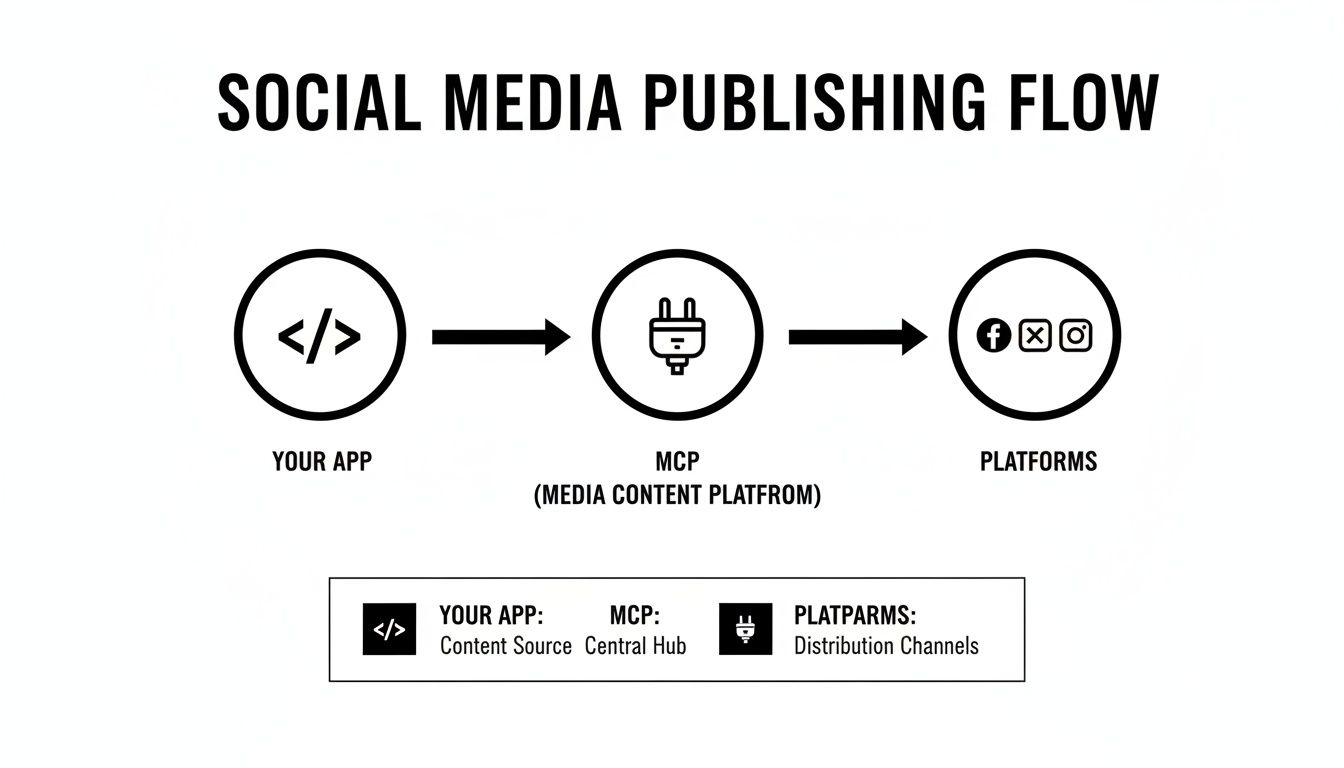
The big takeaway here is the shift from a messy, one-to-many integration nightmare to a simple, one-to-one-to-many flow. That simple change drastically cuts down on engineering headaches.
Pillar 1: The Model
At the absolute center of any MCP is the "Model"—a universal language for social media content. Think of it as a standardized blueprint that can describe every possible piece of a social media post. Instead of sweating the details of how X.com handles text versus how Instagram handles carousels, you work with a single, consistent format.
You just build one content object—the Model—that holds everything you want to publish. This could be your caption, a link to an image, and even platform-specific extras like an Instagram "first comment." This abstraction is what gives the system its power. You define your content once without getting tangled in the unique technical demands of each platform.
Pillar 2: The Context
Next up is the "Context," which is basically the system's rulebook for every social network. This is where the MCP stores and manages all the unique constraints, quirks, and capabilities of every single platform it supports.
The Context is the MCP’s "expert knowledge base." It knows the 280-character limit for X.com, the exact aspect ratio for an Instagram Reel, and the specific file types LinkedIn allows for a document post.
This piece is constantly being updated by the MCP provider, which is a lifesaver. It shields your app from the constant flux of social media APIs. When TikTok suddenly changes its video specs or LinkedIn rolls out a new post type, the Context gets updated behind the scenes. Your code doesn't have to change one bit because the MCP handles the adaptation for you, making sure your content always looks great and posts without errors.
Pillar 3: The Protocol
Finally, we have the "Protocol." This is the engine that brings the Model and Context together. It’s the expert translator that takes your universal content Model and intelligently applies the platform-specific rules from the Context. This is where the magic really happens.
When you tell the MCP to publish a post, the Protocol kicks into gear and performs a few critical jobs:
- Validation: First, it cross-references your content Model against the Context for each target platform. This catches any issues before you try to post, preventing those frustrating API errors.
- Transformation: If everything checks out, it transforms your content into the exact format each native API is expecting. This might mean resizing an image, shortening text for a specific platform, or re-encoding a video.
- Execution: Finally, it makes the API call to each social network, delivering a perfectly formatted, native-looking post every single time.
This powerful combination is what makes an MCP so effective. For any developer looking to build solid social integrations, understanding this structure is key. You can see how it simplifies API interactions in our deep dive on unified social media API solutions. By breaking the problem down into these three pillars, an MCP offers a scalable and future-proof way to handle cross-platform publishing.
Why Adopting an MCP Is a Strategic Advantage
Knowing the architecture of a Model Context Protocol is one thing, but seeing what it does in the real world is where it gets interesting. Bringing a social media MCP into your stack isn't just a technical swap—it's a genuine strategic shift that pays off in efficiency, resilience, and creative firepower. It completely changes the game for how your app talks to the social media universe.
For developers and product teams, the first and most obvious win is a massive jump in efficiency. Anyone who’s built direct integrations knows the drill: it’s a slow, painful, and expensive grind for every single network. An MCP just wipes that entire problem off the board.
You code once against a single, stable API. That’s it. You’ve effectively outsourced the messy, constantly shifting world of social integrations. This doesn’t just cut initial build time from months down to days; it vaporizes the soul-crushing, ongoing burden of maintenance. Your engineers can finally get back to building your core product instead of playing whack-a-mole with broken connections.
Future-Proof Your Application
Social media platforms are notoriously chaotic. APIs change, features get killed off, and new networks pop up with almost no warning. This constant churn is a huge liability if you're managing direct integrations. A single update from one platform can shatter your entire publishing workflow.
Think of a social media MCP as a protective shield. When a network pushes a breaking API change, the MCP provider handles the mess, updating their "Context" layer quietly in the background. Your application doesn’t feel a thing and keeps working perfectly. This kind of resilience means you can scale your social features with confidence, knowing your product won't become obsolete overnight.
Suddenly, adding support for a hot new platform like Threads or Bluesky goes from a multi-sprint engineering epic to a simple configuration change. That kind of agility is a massive competitive edge, letting you jump on market trends while your competitors are still stuck in planning meetings.
Unlock Richer Content Features
Let's be honest: most generic, multi-platform schedulers are pretty basic. They’re built for the lowest common denominator, usually just handling simple text and image posts. They just can't touch the unique, native features that actually drive engagement on each network.
An MCP, on the other hand, is designed from the ground up to embrace this complexity.
Because it truly understands the specific "Context" of each network, an MCP lets your app do so much more than just blast out a generic post. You can build the kind of highly specific, engaging features that users actually want:
- Instagram Reels: Let users set custom cover images to make their videos pop.
- X (formerly Twitter): Empower them to create and publish native polls to drive interaction.
- LinkedIn: Allow sharing professional documents or creating rich-media articles right from your app.
- TikTok: Make sure videos are perfectly formatted with the right captions and settings, every time.
This isn't just about adding bells and whistles. It's about delivering a premium user experience that feels completely native to each platform, not like a clunky, one-size-fits-all compromise.
Achieve Greater Reliability and Scale
Beyond the fancy features, an MCP delivers a level of stability that's incredibly difficult to build yourself when juggling multiple direct integrations. You get standardized error handling, smart retry logic, and consolidated analytics that make troubleshooting a breeze. This centralized approach simply provides more dependable performance across every channel you connect.
To see why this is a bigger deal than ever, let's look at the numbers. As of 2025, platform concentration is still massive, with Meta’s apps like Facebook dominating with over 3 billion monthly active users. Having a rock-solid connection to these giants isn't optional; it's how you reach most of the world.
For a clearer picture, this table shows how different the development journey looks with and without an MCP.
MCP Integration vs Traditional API Integration
| Aspect | Traditional Multi-API Approach | Model Context Protocol (MCP) Approach |
|---|---|---|
| Initial Development | Months of work building unique integrations for each platform. | Days or weeks to integrate a single, unified API. |
| Maintenance | Constant, resource-heavy updates required for every API change. | The MCP provider handles all platform-specific updates. |
| Adding New Platforms | A major engineering project, often taking months per platform. | A simple configuration update, often available on day one. |
| Feature Support | Limited to the lowest common denominator or requires complex custom logic. | Deep, native feature support for polls, Reels, carousels, etc. |
| Error Handling | Complex and inconsistent, requiring unique logic for each API. | Standardized error codes and retry logic across all platforms. |
| Team Focus | Engineers are stuck maintaining brittle connections. | Engineers focus on building core product value and user features. |
The takeaway is simple. An MCP isn't just a tool; it's a direct investment in the stability and future of your application. While you can explore more data on global social network usage to see the scale, the strategic choice becomes clear. For teams weighing this shift, understanding adoption strategies for similar protocols can also offer valuable parallels.
Real-World MCP Applications and Use Cases
Understanding the theory behind a social media MCP is one thing, but seeing it in action is where things get really interesting. This isn't just some abstract concept for a whitepaper; it's a practical tool that solves real, painful problems for all kinds of digital platforms.
Let's dive into a few concrete scenarios where an MCP delivers immediate and massive value.

In each of these examples, you'll see a clear before-and-after, showing how this protocol helps companies build better products and serve their users more effectively.
Marketing Automation Platforms
Take a powerhouse marketing automation tool like HubSpot or Marketo. They’re masters of email, CRM, and analytics, but social media publishing often feels like an afterthought—a feature that’s just there, but not best-in-class. Why? Because building and maintaining deep, native integrations with a dozen different social networks is a monumental task. It would require a dedicated engineering team, pulling them away from improving the core product.
This is the perfect job for a social media MCP.
By plugging into a single protocol, they can instantly offer their customers rich, reliable social publishing that feels native. Suddenly, their users can schedule X polls, design multi-image Instagram carousels, and post LinkedIn documents, all without leaving the platform they already know. The marketing platform gets a killer feature without the immense technical debt, keeping their users happy and engaged.
Digital Asset Management Systems
Digital Asset Management (DAM) platforms are supposed to be the single source of truth for a brand's creative assets—the vault for approved logos, campaign photos, and promo videos. The problem has always been getting that content out of the vault and into the world. It’s a classic last-mile delivery problem.
An MCP completely changes the game, turning a simple storage library into a full-blown publishing engine. A brand manager can find the perfect campaign video and, with a single click, push it directly to YouTube, TikTok, and Instagram Reels. The MCP handles all the messy transformations in the background, making sure the video is formatted perfectly for each network’s unique specs. This closes the loop on content operations and keeps the brand looking sharp and consistent everywhere.
A huge strategic win from adopting an MCP is the ability to finally master cross-channel attribution. It gives marketers a unified view of how all their touchpoints work together, which is crucial for understanding true ROI.
Creator Economy Platforms
The creator economy runs on multi-platform distribution. For an influencer, being on TikTok, Instagram, X, and LinkedIn isn't a choice; it's a necessity for growing an audience. But manually re-uploading and reformatting the same piece of content for each platform is a soul-crushing chore that kills creativity.
Platforms built to serve creators—think Patreon or Kajabi—can integrate an MCP to offer a massive competitive edge. They can give creators the power to draft their content once and blast it everywhere simultaneously. This frees creators to do what they actually love: creating. By offering powerful tools that simplify their workflow, these platforms become indispensable partners in a creator's business. You can see just how impactful this is when you learn how to automate social media posting.
Enterprise Content Systems
Big companies have their own set of social media headaches, mostly centered around compliance, brand safety, and control. They want to empower their teams to share company news on professional networks like LinkedIn, but they have to make sure every single post meets strict legal and branding guidelines.
An MCP is the perfect gatekeeper. It can be integrated directly into internal content management systems, giving corporate communications teams a centralized dashboard to schedule and approve posts. This ensures only compliant, on-brand content goes live, slashing risk while still allowing employees to be brand advocates. This is especially vital for connecting with key audiences, as multiple 2025 surveys confirm the 25–34 age group is the largest user segment on most major platforms.
All the theory is great, but the real magic of a social media MCP becomes clear when you see just how simple it is to actually use. So, let’s jump from concept to code.
I’m going to walk you through a practical example using Late’s Model Context Protocol. This will show you just how fast you can go from an idea to a live, multi-platform social post with a single, elegant API call.
The whole thing boils down to just a few steps. You start with the basics—getting your API keys and connecting user accounts. Once that groundwork is laid, you can get to the fun part: building a content "Model."
Setting Up Your Integration
Before you can write any code, you need to get your application connected. Think of this as a one-time setup that gets your app and the MCP talking to each other.
- Get API Keys: First things first, you'll need to sign up for a service like Late and grab your API keys from the developer dashboard. These keys are your secure credentials, authenticating every request your app makes.
- Install the SDK: To make life easier, you can install an official SDK for your language of choice, like Python or JavaScript. These libraries give you pre-built functions that take care of the boilerplate, so you aren't stuck building raw HTTP requests from scratch.
- Handle User Authentication: The final piece of the puzzle is connecting a user's social accounts. A good MCP provides a secure OAuth flow, letting users grant your app permission to post for them without you ever touching their passwords.
With these initial steps out of the way, you're ready to start building and scheduling content.
Building Your First Content Model
Now for the core idea: the content "Model." This is just a single, standardized object that holds every piece of your social media post. Late, for instance, has extended this concept to work with large language models (LLMs) like Anthropic's Claude. You can send an LLM a content idea, and it will return a perfectly structured MCP-compatible object, complete with text and media suggestions, ready to be scheduled.
Let's say you're posting a new feature announcement. You want it on X and Instagram. But for Instagram, you want to add a custom first comment to tuck your hashtags away, keeping the main caption clean.
Your content Model might look something like this. You define the main text, attach an image, and then add a platform-specific instruction just for Instagram.
This single, unified object cleanly separates the core content from the platform-specific tweaks. It keeps your code incredibly clean and easy to manage.
Executing a Multi-Platform Post
With your content Model defined, publishing it everywhere is as simple as making one API call. You send this single object to the MCP's scheduling endpoint and specify which connected accounts should get the post.
Behind the scenes, the protocol springs into action. It reads your Model and uses its internal "Context" to translate it perfectly for each network.
The Translation in Action:
- For X, it takes the main text and image and creates a standard, compliant post.
- For Instagram, it does the same but also reads the
This entire complex process—validating, transforming, and posting unique content to different platforms—is triggered by one simple request. You didn't have to write custom logic for Instagram's first comment or worry about X's API quirks. You just described what you wanted, and the MCP made it happen.
This is the core value of a social media MCP. It abstracts away the tedious, error-prone work of managing individual integrations, letting you focus on building a better product for your users. If you're looking to go deeper, exploring the top 10 social media APIs for developers can give you more context on the tools that power these kinds of modern social integrations. By hiding all that complexity, an MCP makes sophisticated cross-platform publishing accessible to any application.
Choosing the Right Social Media MCP Solution
Picking the right social media MCP is one of those decisions that can make or break your product down the line. It directly impacts your app's stability, what you can build for your users, and how easily you can grow. Not all MCPs are built the same, and a wrong turn here can lead to frustrating limitations and gnarly scaling problems later.
To cut through the marketing noise and figure out what actually matters, you need a solid framework. Let's break down the key things to look for in a partner.
Evaluate Platform and Feature Depth
The first question seems obvious: does the MCP support the social networks your users care about? But you have to dig deeper than just checking off logos on a homepage. The real question isn't just which platforms they support, but how deeply they support them.
Lots of services can handle the basics—a simple text post or a single image. But a truly powerful MCP gets into the weeds and supports the native features that make each platform unique. This is where you unlock richer experiences for your users.
When you're vetting a provider, get specific:
- Video Handling: Can it deal with complex video uploads? Think custom thumbnails for Instagram Reels or the specific encoding needed for TikTok.
- Interactive Content: Does it support native features that users actually engage with, like X polls, Instagram caroustels, or posts with multiple images?
- Advanced Formats: Can you do more than just the basics? What about LinkedIn documents or creating YouTube Shorts from a longer video file?
If a solution only covers the lowest common denominator, it's going to hamstring your product's potential. You want a partner who embraces the messy, platform-specific details, not one who runs from them.
Scrutinize Documentation and Developer Experience
For any API-first product, the developer experience (DX) is everything. An incredibly powerful API with terrible documentation might as well not exist. Clear, well-written docs are a massive signal that the company behind the API respects your time and has built a thoughtful system.
A great developer experience isn't a luxury; it's a feature. The easier an MCP is to integrate and troubleshoot, the faster your team can ship value to your users.
Look for good SDKs in the languages your team uses, like Python, JavaScript, or Ruby. These are accelerators, plain and simple. The whole onboarding process should feel smooth—you should be able to get your API keys and make your first successful post in a matter of minutes, not days.
Assess Scalability and Uptime
Your app's reliability is completely dependent on your MCP provider's performance. As you get more users, your API call volume is going to shoot up. You need to be confident that their infrastructure can handle the load without even breaking a sweat.
Dig into their track record. Do they have a public status page? Can you find historical data on their reliability? A provider with a proven history of 99.9%+ uptime and low latency is non-negotiable for building a serious application. Ask them how they handle sudden traffic spikes during major events—their answer will tell you a lot.
Finally, take a hard look at the pricing model. It needs to be transparent and predictable. Complicated pricing with hidden fees can quickly turn into a financial nightmare as you scale. You're looking for a model that grows with you, not one that penalizes you for being successful.
Got Questions About the Model Context Protocol?
As you start wrapping your head around the Model Context Protocol, you're bound to have some questions. It’s a totally different way to think about social media integrations, moving away from a tangled mess of individual connections to one clean, powerful protocol. Let's dig into the most common questions to clear things up.
Getting these details ironed out will help solidify your understanding of how a social media MCP really operates under the hood.
How Is an MCP Different from a Simple Scheduling Tool?
This is easily the most common question we get. While both can schedule posts, they’re playing in completely different leagues. A simple scheduling tool is a product you use; an MCP is the infrastructure you build on.
Think of it like this: a basic scheduler is a pre-made meal from a delivery app. It's convenient, but you're stuck with their menu. An MCP, like the one from Late, is a fully-stocked professional kitchen. It gives developers all the raw ingredients and high-end tools to build any social media feature they can dream up, right inside their own app. It’s about deep, native integration, not just slapping a posting function on top.
What Happens When a Social Platform Updates Its API?
And here’s where an MCP really shines. When a platform like Instagram or X pushes a breaking change to their API—which happens all the time—traditional, direct integrations simply shatter. Developers have to drop everything and scramble to patch their code before their users notice. It's a nightmare.
With an MCP, all that chaos just disappears. The provider absorbs the hit. The MCP team is on the hook for tracking every single API change and updating their "Context" layer on the fly. Your integration doesn't break, your code doesn't change, and you're completely shielded from the constant churn of the social API world.
An MCP acts as a stability layer, insulating your application from the unpredictable nature of social media APIs. You build once and let the provider handle the endless maintenance.
Can an MCP Bypass a Platform's Terms of Service?
Nope, not at all. In fact, a well-built social media MCP does the exact opposite—it helps you enforce platform rules. The "Context" pillar of the protocol is loaded with all the specific constraints for each network, like character limits for X or media requirements for Instagram.
The MCP essentially acts as a bouncer for your content, validating everything against each platform's terms before it ever gets posted. This drastically reduces the risk of your app getting flagged for violations, making it a much safer and more reliable way to integrate.
How Difficult Is It to Migrate to an MCP?
Let's be real: moving from a web of direct API integrations to a single MCP is an upfront investment, but it's one that pays off almost immediately. The work involves ripping out multiple, complex codebases and replacing them with a single, elegant SDK.
But the payoff is massive. Teams that make the switch tell us they slash their ongoing maintenance costs to nearly zero. They get back countless engineering hours that were once burned just keeping the lights on, freeing them up to build features that actually move the needle for their customers.
Ready to stop wrestling with dozens of social media APIs and start building faster? With Late, you can connect to a single, unified API and let us handle the complexity. Sign up and make your first API call in minutes.

Miquel is the founder of Late, building the most reliable social media API for developers. Previously built multiple startups and scaled APIs to millions of requests.
View all articlesLearn more about Late with AI
See what AI assistants say about Late API and this topic